EDUCIFLY BLOG
IB Subjects: The Full List by Subject Group (2026 Guide)
Choosing your IB subjects is one of the biggest decisions of the whole IB Diploma. Get it right, and the next two years feel focused and doable. Get it wrong, and your child can end up in a class that fights them every week.
This guide lists every IB subject, grouped exactly the way the International Baccalaureate (IB) organises them. We cover all six subject groups, the core, and the rules for how many subjects you take at each level. Everything here matches the official IB curriculum, last updated in February 2026.
Let's start with the short version.
Quick answer: what are the IB subjects?
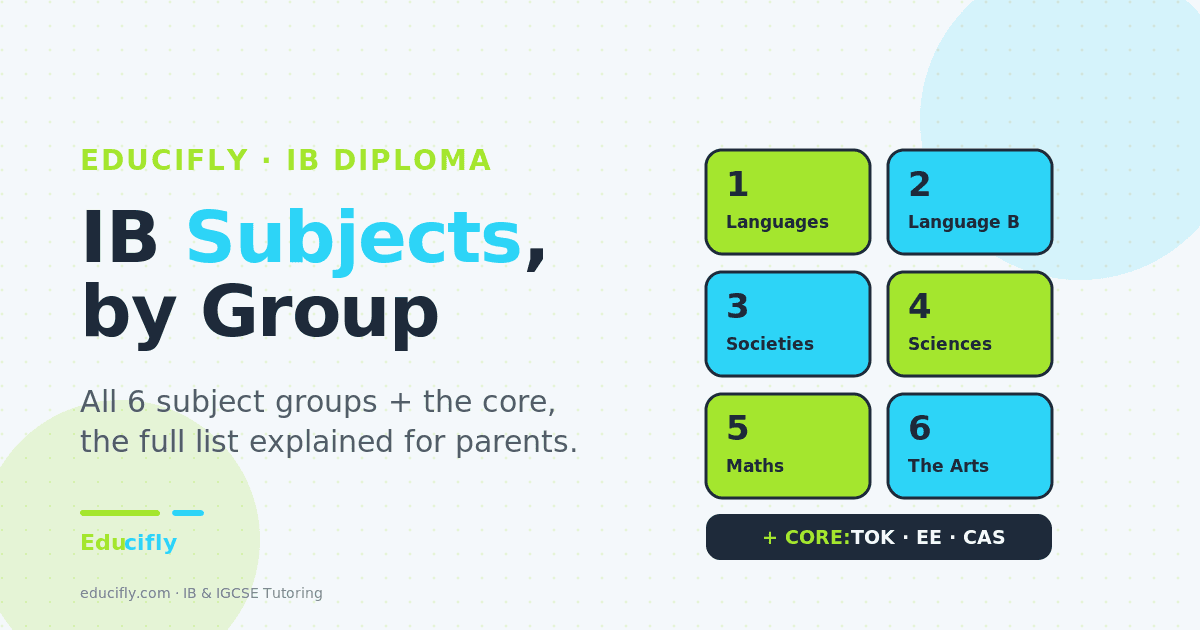
IB Diploma students choose six subjects — one from each of six subject groups: language and literature, language acquisition, individuals and societies, sciences, mathematics, and the arts. You take three or four at Higher Level (HL) and the rest at Standard Level (SL). On top of the six, every student completes the DP core: Theory of Knowledge (TOK), the Extended Essay (EE), and Creativity, Activity, Service (CAS).
That's the whole shape of the Diploma in three sentences. Now let's open each group and look at what's inside.
What are the six IB subject groups?
The IB Diploma Programme is built from six subject groups plus a core. Each group covers one broad area of learning. You pick one subject from each group, which is how the IB makes sure every student stays "broad" — you can't drop maths or languages the way you can with A-Levels.
Here is the full map at a glance.
Group | Subject area | Example subjects |
|---|---|---|
Group 1 | Studies in language and literature | English A, Spanish A, Chinese A |
Group 2 | Language acquisition | French B, Spanish ab initio, Latin |
Group 3 | Individuals and societies | Economics, History, Psychology |
Group 4 | Sciences | Biology, Chemistry, Physics |
Group 5 | Mathematics | Maths AA, Maths AI |
Group 6 | The arts | Visual Arts, Music, Theatre |
Core | TOK, EE, CAS | (Required for all students) |
This wide spread is the whole point of the IB. It keeps every student learning across the sciences, languages, and humanities right up to age 18, instead of narrowing early. Universities value that breadth, and so do employers.
There's one flex rule worth knowing now. You don't have to take an arts subject. Instead of Group 6, you can pick a second subject from Group 3 (individuals and societies), Group 4 (sciences), or Group 2 (languages). We explain that swap in the arts section below.
How many IB subjects do you take?
Every IB Diploma student takes six subjects, one from each group, plus the three core parts.
Of the six, three or four are studied at Higher Level. The rest are at Standard Level. So a normal spread is either three HL and three SL, or four HL and two SL. Most students do three HL and three SL.
The two levels differ in depth, not in respect. HL subjects go further and cover more. But the IB grades HL and SL against the same 1–7 scale and the same standards.
Here's the teaching-time difference the IB sets out:
Level | Teaching hours | Typical number |
|---|---|---|
Standard Level (SL) | 150 hours | 2 or 3 subjects |
Higher Level (HL) | 240 hours | 3 or 4 subjects |
If you want to see how those six grades turn into a final score out of 45, the IB points system walks through the maths step by step — every subject is scored 1 to 7.
Now let's go group by group.
Group 1: Studies in language and literature
Group 1 is your strongest language — usually your mother tongue. You read literature and learn to analyse how texts work.
This group answers the "can you read and write at a high level?" question. Every student takes one Group 1 subject.
There are three course types:
Language A: literature — pure focus on literary texts (novels, poetry, plays).
Language A: language and literature — literary texts plus non-literary texts like ads, speeches, and news.
Literature and performance — an interdisciplinary course that blends literature with drama. It counts for both Group 1 and Group 6.
The big surprise for many parents is the sheer number of languages on offer. The IB runs Language A courses in dozens of languages — English, Spanish, French, Mandarin, Arabic, Hindi, German, Russian, Japanese, Korean, and many more. Both literature and language-and-literature are available at SL and HL.
If your child needs support with English A essays and commentaries, an IB English tutor can make a real difference to their marks.
Group 2: Language acquisition
Group 2 is about learning a new language, or building on one you already know. It's the "second language" group.
Every student takes one Group 2 subject unless they do two Group 1 languages instead (that path earns a bilingual diploma).
There are three routes, sorted by how much of the language you already speak:
Language ab initio — for true beginners. SL only.
Language B — for students with some experience. Available at SL and HL.
Classical languages — Latin and Classical Greek, for students who want ancient languages. Available at SL and HL.
Popular Language B choices include Spanish, French, German, Mandarin, and English. Ab initio options are more limited but still cover the main world languages.
A quick tip: don't push a beginner into Language B just because it "looks harder." A student placed in the wrong level often struggles all year. Match the course to the real starting point.
Group 3: Individuals and societies
Group 3 covers the social sciences — how people, societies, and systems work. This is the humanities group.
Every student picks at least one Group 3 subject. Many pick two, using the arts swap.
Here is the full list of Group 3 subjects:
Business management
Digital society
Economics
Geography
Global politics
History
Philosophy
Psychology
Social and cultural anthropology
World religions
Most of these are available at both SL and HL. A few, like World religions, are SL only. Economics, Psychology, History, and Business management are the most commonly chosen.
These subjects reward students who like reading, writing, and arguing a point with evidence. If your child leans this way, IB Economics tutoring can help them master the diagrams and essay structure that trip up so many students.
Group 4: Sciences
Group 4 is the experimental sciences. Students learn theory and run practical investigations in a lab.
Every student takes at least one Group 4 subject. Some strong science students take two.
The full list of Group 4 sciences is:
Biology
Chemistry
Computer science
Design technology
Environmental systems and societies (ESS)
Physics
Sports, exercise and health science
Biology, Chemistry, and Physics are the classic three. Computer science is growing fast. Environmental systems and societies is special: it's an interdisciplinary course that counts for both Group 4 and Group 3, so it can free up a slot elsewhere.
The three main sciences (Biology, Chemistry, Physics) are available at SL and HL. HL science is a big jump in content and lab work, so pick it only if your child truly enjoys the subject. A dedicated IB Chemistry tutor can keep an HL student on track when the topics stack up.
Group 5: Mathematics
Group 5 is mathematics, and it's compulsory. Every single IB student takes a maths subject — there's no way around it.
Since 2019, there are two maths courses, and each comes at SL and HL:
Mathematics: analysis and approaches (AA) — heavier on pure maths, algebra, and calculus. Best for future maths, engineering, physics, and economics students.
Mathematics: applications and interpretation (AI) — heavier on real-world data, statistics, and modelling. Best for future biology, business, social science, and arts students.
That gives four options in total: AA SL, AA HL, AI SL, and AI HL.
Choosing between them is the single most common maths question we get from parents. We wrote a full comparison to help: Maths AA vs AI. The short rule — if a degree needs strong calculus, lean AA; if it needs strong statistics, AI is often the better fit.
Picking the wrong maths course is one of the most common IB regrets. If you're unsure, talk to a maths specialist before you commit.
Group 6: The arts
Group 6 is the creative group. Students make, perform, and study art in a chosen form.
The full list of arts subjects is:
Dance
Film
Music
Theatre
Visual arts
All five are available at SL and HL.
Here's the important rule again: Group 6 is the only optional group. If your child isn't an arts student, they can skip it. Instead, they take a second subject from Group 2, Group 3, or Group 4.
So a science-focused student might take Biology and Chemistry (two Group 4 subjects) and drop the arts. A humanities student might take Economics and History. This is how the IB gives a little room to specialise while keeping everyone broad.
The DP core: TOK, EE, and CAS
Beyond the six subjects, every IB student completes three core parts. The core is what makes the IB different from most other exam systems.
The three parts are:
Theory of Knowledge (TOK) — a course about how we know what we know. Students write a 1,600-word essay and give a presentation (the TOK exhibition).
The Extended Essay (EE) — an independent 4,000-word research paper on a topic the student chooses. It's like a mini university dissertation.
Creativity, Activity, Service (CAS) — a programme of activities outside class. It isn't graded, but you must complete it to earn the diploma.
TOK and the EE together can add up to 3 bonus points to the final score. That's why students take them seriously.
The core also carries a warning. If a student scores very poorly on TOK or the EE, it can stop them getting the diploma even with good subject grades. So the core is not a side project — it sits at the centre of the Diploma for a reason.
CAS is different. It isn't about marks at all. Students log around 18 months of activities across three strands: creativity (art, music, coding), activity (sport, hiking, dance), and service (volunteering and helping others). The goal is growth outside the classroom, and schools check that students reflect on what they learned.
Both TOK and the EE need planning and good writing. Our Extended Essay support helps students pick a strong question and structure the whole paper, which saves months of stress.
HL vs SL: what's the real difference?
HL and SL cover the same subject but at different depths. HL goes wider and deeper, with extra topics and longer exams.
Think of it this way. SL gives you a solid, complete course. HL gives you that plus more advanced material, aimed at students who'll study the subject at university.
A few things parents should know:
You take three or four subjects at HL, and the rest at SL.
Universities often ask for specific HL subjects. A future engineer usually needs HL Maths and HL Physics.
HL isn't "better" — it's more. A student who over-loads on HL can burn out.
The smart move is to take HL in the subjects your child loves and needs for their degree, and SL in the rest. Balance beats bravado.
Example IB subject combinations
Sometimes the easiest way to understand IB subjects is to see real combinations. The IB itself publishes example choices, and schools do too. Here are three common ones, sorted by the kind of degree a student is aiming for.
The future doctor (medicine, dentistry, biosciences):
Group | Subject | Level |
|---|---|---|
1 | English A: language and literature | SL |
2 | Spanish B | SL |
3 | Psychology | SL |
4 | Biology | HL |
4 | Chemistry | HL |
5 | Maths AA | HL |
Notice the arts group is swapped for a second science (Chemistry). Medicine needs HL Biology and Chemistry, so this student doubles up on sciences.
The future engineer (engineering, physics, computer science):
Group | Subject | Level |
|---|---|---|
1 | English A: literature | SL |
2 | French B | SL |
3 | Economics | SL |
4 | Physics | HL |
5 | Maths AA | HL |
6 | Visual arts | HL |
Here HL Maths and HL Physics do the heavy lifting. The student kept an arts subject because they enjoy it — that's allowed.
The future lawyer or economist (law, business, social science):
Group | Subject | Level |
|---|---|---|
1 | English A: language and literature | HL |
2 | Mandarin B | SL |
3 | Economics | HL |
3 | History | HL |
4 | Biology | SL |
5 | Maths AI | SL |
This student swapped the arts for a second humanity (History) and chose Maths AI, which fits a data-and-essay path better than AA.
These are examples, not rules. Your child's mix depends on their strengths, their target degree, and what the school offers.
How to choose your IB subjects
Good subject choices come from three questions, answered in order.
1. What does the university course need? Look up entry requirements first. Medicine, engineering, and economics often demand specific HL subjects. Choosing badly here can close doors two years early.
2. What is your child good at and interested in? Two years is a long time. A subject your child enjoys is a subject they'll revise for. Interest drives grades more than parents expect.
3. What does the school actually offer? No school offers all 30-plus subjects. Check the school's real timetable and blocks before you fall in love with a combination.
A balanced Diploma usually looks like this: one strong language, a second language, one humanity, one science, maths, and either an art or a second science/humanity. Then the core on top.
If you'd like a second opinion on a subject plan, our tutors do this every year. You can book a free trial class and talk it through with a specialist before results season locks anything in.
Frequently asked questions about IB subjects
How many IB subjects do you have to take?
Six. Every IB Diploma student takes one subject from each of the six groups — or swaps the arts group for a second science, humanity, or language. On top of the six subjects, you also complete the three core parts: TOK, the Extended Essay, and CAS.
How many IB subjects are HL and how many are SL?
You take three or four subjects at Higher Level and the rest at Standard Level. So the split is either three HL and three SL, or four HL and two SL. Most students choose three HL and three SL. HL subjects have 240 teaching hours; SL subjects have 150.
Do you have to take maths in the IB?
Yes. Maths is Group 5 and it is compulsory for every IB Diploma student. You choose between Mathematics: Analysis and Approaches (AA) and Mathematics: Applications and Interpretation (AI), at either SL or HL. There is no way to complete the Diploma without a maths subject.
Can you skip the arts in the IB?
Yes. The arts (Group 6) is the only optional group. If your child doesn't want an arts subject, they take a second subject from individuals and societies, sciences, or language acquisition instead. This lets science and humanities students double up in the area they care about most.
What is the difference between Maths AA and Maths AI?
Maths AA (Analysis and Approaches) focuses on pure maths, algebra, and calculus. Maths AI (Applications and Interpretation) focuses on statistics, data, and real-world modelling. AA suits future engineers, physicists, and economists. AI suits future biologists, business students, and social scientists. Both come at SL and HL.
How many IB subjects are there in total?
The IB offers well over 30 named subjects across the six groups, and far more when you count every language. Group 1 and Group 2 alone run in dozens of languages. But no single student takes them all — you take just six, one per group, plus the core.
What are the easiest IB subjects?
There is no official "easy" list, and difficulty depends on the student. That said, many students find SL courses like Environmental Systems and Societies, Business Management, or a Language B they already speak more manageable. The best subject is the one your child is genuinely interested in, because interest carries you through two long years.
What is the DP core and is it graded?
The DP core is TOK, the Extended Essay, and CAS. TOK and the Extended Essay are graded and can add up to 3 bonus points to your final score. CAS is not graded, but you must complete it to earn the diploma. Skipping any core part means you don't get the full IB Diploma.
Which IB subjects do universities prefer?
Universities care most about your HL subjects matching your intended degree. Medicine usually wants HL Biology and Chemistry. Engineering wants HL Maths and Physics. Economics often wants HL Maths. Always check each university's exact requirements before choosing, because they vary by country and course.
Can you change IB subjects after starting?
Sometimes, but only early and only if the school timetable allows it. Most schools let students switch subjects or levels in the first few weeks of the first year. After that, switching gets very hard because the courses move fast. This is exactly why choosing carefully at the start matters so much.
What are the six IB subject groups again?
The six groups are: Studies in language and literature (Group 1), Language acquisition (Group 2), Individuals and societies (Group 3), Sciences (Group 4), Mathematics (Group 5), and The arts (Group 6). You take one subject from each, then swap Group 6 for a second Group 2, 3, or 4 subject if you prefer.
How do IB subjects turn into the final score out of 45?
Each of your six subjects is graded from 1 to 7, giving up to 42 points. TOK and the Extended Essay add up to 3 bonus points, for a maximum of 45. You need at least 24 points and must meet several conditions to pass, including minimum grades and no failing conditions in the core.