EDUCIFLY BLOG
AP Physics 1 vs 2 vs C: The Differences, Difficulty and How to Choose for 2027
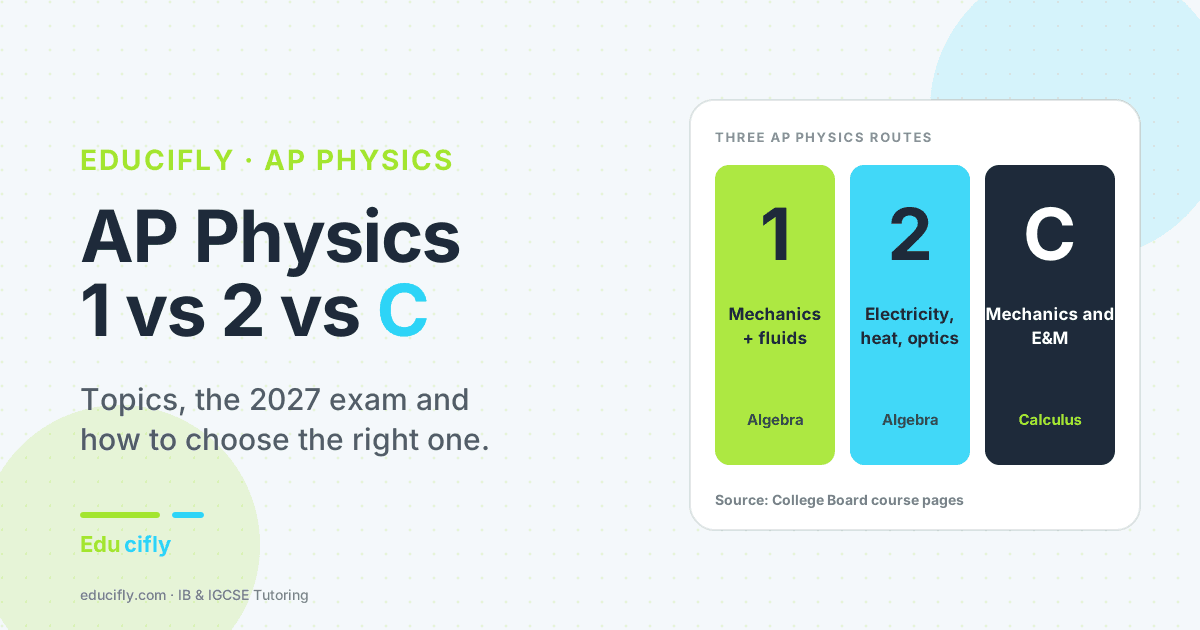
AP Physics 1 vs 2 is the first choice most science-minded students face, and AP Physics C makes it a three-way decision. The names sound like a ladder. They aren’t. Physics 1 and Physics 2 are two separate algebra-based courses, and Physics C is a calculus-based course that is split into two exams.
This guide puts all four AP physics exams side by side. You’ll get the College Board’s real numbers, the 2027 exam format, the topics in each course, and a clear way to pick. You’ll also find out whether AP Physics 2 is hard, and what the order of the courses should be.
Quick answer: what is the difference between AP Physics 1, 2 and C?
Quick answer: AP Physics 1 covers mechanics and fluids using algebra. AP Physics 2 covers thermodynamics, electricity, magnetism, optics and modern physics using algebra. AP Physics C uses calculus and has two separate exams: Mechanics, and Electricity and Magnetism. In May 2026, 68% of Physics 1 students, 72% of Physics 2 students and 72% to 75% of Physics C students scored a 3 or higher. Choose by your maths level first, then by the topics you want.
Here is the short version in a table.
AP Physics 1 | AP Physics 2 | AP Physics C: Mechanics | AP Physics C: E&M | |
|---|---|---|---|---|
Maths used | Algebra and trig | Algebra and trig | Calculus | Calculus |
Main topics | Motion, forces, energy, momentum, rotation, oscillations, fluids | Heat, electric fields, circuits, magnetism, optics, waves, modern physics | Motion, forces, energy, momentum, rotation, oscillations | Electric fields, potential, capacitors, circuits, magnetism, induction |
Exam length | 3 hours | 3 hours | 3 hours | 3 hours |
2027 exam date | Wed 5 May, Session 2 | Thu 6 May, Session 1 | Mon 3 May, Session 1 | Wed 5 May, Session 2 |
2026 score of 3+ | 68% | 72% | 72% | 75% |
2026 score of 5 | 19% | 20% | 20% | 24% |
AP Physics 1 vs 2: what is the main difference?
The main difference between AP Physics 1 and AP Physics 2 is the topics. They are two different courses, not a first half and a second half. Both use algebra, and both ask you to explain ideas in words, not only to solve equations.
AP Physics 1 is the mechanics course. On the College Board’s current unit list, it has eight units:
Unit 1: Kinematics (10% to 15% of the multiple-choice section)
Unit 2: Force and Translational Dynamics (18% to 23%)
Unit 3: Work, Energy, and Power (18% to 23%)
Unit 4: Linear Momentum (10% to 15%)
Unit 5: Torque and Rotational Dynamics (10% to 15%)
Unit 6: Energy and Momentum of Rotating Systems (5% to 8%)
Unit 7: Oscillations (5% to 8%)
Unit 8: Fluids (10% to 15%)
AP Physics 2 picks up where the topics change. It has seven units, numbered 9 to 15 because they follow on from Physics 1:
Unit 9: Thermodynamics (15% to 18%)
Unit 10: Electric Force, Field, and Potential (15% to 18%)
Unit 11: Electric Circuits (15% to 18%)
Unit 12: Magnetism and Electromagnetism (12% to 15%)
Unit 13: Geometric Optics (12% to 15%)
Unit 14: Waves, Sound, and Physical Optics (12% to 15%)
Unit 15: Modern Physics (12% to 15%)
Notice what moved. Fluids now sits in Physics 1 (Unit 8), and there is no electricity in Physics 1 at all. Older guides, and some older textbooks, still put fluids in Physics 2 and electricity in Physics 1. If you read a comparison that says so, check its date.
The College Board’s course pages list no formal prerequisite for either course. Your school sets its own rules. Educifly’s view is simple: take Physics 1 first if you can. Physics 2 reuses the same habits, such as free-body diagrams, energy bar charts and “explain your reasoning” answers.
What does AP Physics C cover, and why is it different?
AP Physics C is the calculus-based track, and it is built as two separate courses with two separate exams. Many schools teach both in one year, but you can sit one or both.
AP Physics C: Mechanics has seven units:
Unit 1: Kinematics (10% to 15%)
Unit 2: Force and Translational Dynamics (20% to 25%)
Unit 3: Work, Energy, and Power (15% to 25%)
Unit 4: Linear Momentum (10% to 20%)
Unit 5: Torque and Rotational Dynamics (10% to 15%)
Unit 6: Energy and Momentum of Rotating Systems (10% to 15%)
Unit 7: Oscillations (10% to 15%)
AP Physics C: Electricity and Magnetism has six units, numbered 8 to 13:
Unit 8: Electric Charges, Fields, and Gauss’s Law (15% to 25%)
Unit 9: Electric Potential (10% to 20%)
Unit 10: Conductors and Capacitors (10% to 15%)
Unit 11: Electric Circuits (15% to 25%)
Unit 12: Magnetic Fields and Electromagnetism (10% to 20%)
Unit 13: Electromagnetic Induction (10% to 20%)
The topics overlap with Physics 1 for mechanics and with Physics 2 for electricity. The depth does not. Physics C uses derivatives and integrals to build the ideas from scratch. Gauss’s Law, for example, has its own unit in Physics C: E&M.
The College Board course pages list no prerequisites for Physics C either. In practice, you need to be comfortable with calculus. If you aren’t yet, our guides on AP Precalculus and AP Calculus AB vs BC show which maths course gets you there.
How are the four AP physics exams set out?
All four AP physics exams now use the same shape. Each one is 3 hours long, with two equal sections, and you get an equation sheet and a reference table.
Part of the exam | What you get |
|---|---|
Section 1: multiple choice | 42 questions in 1 hour 25 minutes, 50% of your score |
Section 2: free response | 4 questions in 1 hour 35 minutes, 50% of your score |
Format | Hybrid digital: you read the questions and answer multiple choice in the Bluebook app, then hand-write free-response answers in paper booklets |
Calculator | Allowed, from the College Board’s approved list |
Reference materials | Equation sheet and reference tables provided |
Do the sums and the pace is clear. 85 minutes for 42 questions is about 2 minutes per question. 95 minutes for 4 free-response questions is about 24 minutes each. That is not a lot of time for a multi-step physics problem.
Physics 2, Physics C: Mechanics and Physics C: E&M each have one free-response question of each of four types: mathematical routines, translation between representations, experimental design and analysis, and qualitative/quantitative translation. In other words, one question asks you to design an experiment, and one asks you to explain your answer in words as well as numbers. Those two question types catch out students who only practise calculations.
What changes on the AP physics exams in May 2027?
The number of multiple-choice questions goes up and the timings change, but the content stays the same. For Physics 2, the older format was 40 multiple-choice questions in 80 minutes and 4 free-response questions in 100 minutes. The 2027 format is 42 questions in 85 minutes and 4 free-response questions in 95 minutes.
The College Board describes the change as minor. The units, topics and skills are the same. Two practical points for you:
If you use a practice test written before the change, it has two fewer multiple-choice questions than the real exam.
You have 5 minutes less for free response than in the older Physics 2 format, and 5 minutes more for multiple choice. Practise writing complete answers faster.
All four courses also have small clarifications to course conventions in the 2026-27 course and exam description. Your teacher will have these. Our post on whether AP Physics 1 is hard covers the Physics 1 exam in more detail.
One more thing to check. Physics 1 and Physics C: E&M are both listed in Session 2 on Wednesday 5 May 2027. If you plan to sit both in the same year, ask your AP coordinator early how your school will handle it.
How do the pass rates compare for AP Physics 1, 2 and C?
The pass rates are close, and AP Physics 1 has the lowest. These are the College Board’s 2026 score distributions.
Exam (2026) | Score of 5 | Score of 4 | Score of 3 | Score of 2 | Score of 1 | Score of 3+ |
|---|---|---|---|---|---|---|
AP Physics 1 | 19% | 24% | 25% | 15% | 17% | 68% |
AP Physics 2 | 20% | 29% | 23% | 21% | 7% | 72% |
AP Physics C: Mechanics | 20% | 25% | 27% | 17% | 11% | 72% |
AP Physics C: E&M | 24% | 24% | 27% | 17% | 8% | 75% |
The 2025 numbers show how many students sit each exam, which matters when you read the percentages.
Exam (2025) | Students | Mean score | Score of 5 | Score of 3+ |
|---|---|---|---|---|
AP Physics 1 | 174,401 | 3.12 | 19.8% | 67.3% |
AP Physics 2 | 24,211 | 3.38 | 21.8% | 72.6% |
AP Physics C: Mechanics | 65,980 | 3.30 | 21.7% | 73.2% |
AP Physics C: E&M | 29,708 | 3.38 | 25.2% | 72.9% |
Physics 1 had about 7 times as many students as Physics 2 in 2025. It is the course almost everyone starts with, so its results include students at every level.
Does a higher pass rate mean an easier exam?
No. A higher pass rate mostly tells you who chose the course. It does not tell you how hard the questions are.
Physics C has a smaller group of students, and they have already passed calculus or are taking it at the same time. Students who pick Physics C tend to be strong at maths and keen on physics. They would score well on almost any exam. Physics 1 has the widest group, so it has the widest spread of scores.
So don’t pick a course because its pass rate is a few points higher. Pick the one that fits your maths level and your plans. A student who is weak at calculus and joins Physics C for the pass rate will find it very hard.
Is AP Physics 2 hard?
Yes, AP Physics 2 is hard, but most students who take it do well. In 2026, 72% scored a 3 or higher and 20% scored a 5. The course is hard for three reasons.
First, the topics are wide. You go from heat engines to circuits to lenses to quantum ideas in one year. There is less time to go deep on each one than in Physics 1.
Second, the ideas are less familiar. Everyone has an instinct for a ball falling. Very few people have an instinct for a magnetic field or a photon.
Third, you must explain and design, not only calculate. Experimental design is one of the four free-response question types, and it takes practice.
The pass rate has also changed a lot. Here is the College Board’s history for Physics 2.
Year | Score of 5 | Score of 4 | Score of 3 | Score of 2 | Score of 1 | Score of 3+ |
|---|---|---|---|---|---|---|
2026 | 20% | 29% | 23% | 21% | 7% | 72% |
2025 | 21.8% | 28.8% | 22.0% | 20.2% | 7.2% | 72.6% |
2024 | 19.1% | 18.0% | 33.4% | 22.9% | 6.6% | 70.5% |
2023 | 16.5% | 18.5% | 34.9% | 23.8% | 6.4% | 69.9% |
2022 | 16.3% | 18.1% | 35.3% | 24.1% | 6.3% | 69.7% |
2021 | 15.4% | 17.9% | 32.0% | 27.0% | 7.6% | 65.3% |
The pass rate hasn’t moved much. What changed is the top end. Between 2024 and 2025, the share of 4s rose from 18.0% to 28.8%, and the mean score rose from 3.20 to 3.38. The College Board hasn’t said why, so treat it as a trend, not a promise.
Is AP Physics C harder than AP Physics 2?
The maths is harder in Physics C, and the topics are narrower. Physics 2 asks you to cover seven different areas with algebra. Physics C asks you to go deep on mechanics, or on electricity and magnetism, with calculus.
Here is a fair way to compare them.
Question | AP Physics 2 | AP Physics C |
|---|---|---|
Maths level | Algebra and trig | Calculus (derivatives and integrals) |
Breadth | Seven areas in one exam | One area per exam |
Depth | Moderate | Deep |
Hardest skill | Explaining and designing in words | Setting up and solving with calculus |
Exams to sit | One | One or two |
If you like maths and enjoy seeing where formulas come from, Physics C is often more satisfying. If calculus feels shaky, Physics 2 is the safer choice, because a weak calculus base turns Physics C into two maths courses at once.
Which AP Physics should I take?
Start with your maths, then check your goals. This table is Educifly’s own guide, not a College Board rule.
Your situation | A sensible first choice |
|---|---|
Finished Algebra 2, no calculus yet | AP Physics 1 |
Took Physics 1 and want more topics, no calculus | AP Physics 2 |
Taking or finished calculus, love maths | AP Physics C: Mechanics, then E&M |
Took Physics 1, strong at calculus | AP Physics C |
Want an engineering or physics degree | Physics C if you can, as it matches college physics |
Want a life science or medical degree | Physics 1, then Physics 2 |
Short on time and want one exam | The course that matches your maths |
Three notes to go with the table.
Check what your school offers. Many schools don’t run all four courses. Some only run Physics 1. Some run Physics C only as a combined course.
Check college credit. Colleges set their own AP credit rules. Some accept Physics C for engineering physics but not Physics 1 or 2. Look up the AP credit policy of two or three colleges you like before you choose.
Check your timetable. Physics C is two exams. Each exam costs the same fee. The College Board’s 2027 fee is $99 in the US and $129 outside the US per exam, so two Physics C exams cost double.
Should I take AP Physics 1 before AP Physics 2?
Usually yes, but the College Board doesn’t require it. Physics 2 uses the same habits as Physics 1, such as free-body diagrams and conservation of energy. It also uses the same style of “explain why” questions. A student who skips Physics 1 has to learn those habits and a new set of topics at the same time.
There is one common exception. A student who is strong at calculus can go straight to Physics C: Mechanics. It covers the same mechanics ideas as Physics 1 with calculus. Many schools then add Physics C: E&M the same year or the year after.
Some students also take Physics 2 and Physics C in the same year after Physics 1. That is a heavy load. Only do it if you love physics and have space in your timetable.
What does the same idea look like in each course?
A short example shows the real gap between the courses. Take a 2.0 kg cart that starts at rest and gets pushed along a smooth track.
In AP Physics 1, the push is a steady 6.0 N. You use F = ma, so the acceleration is 3.0 m/s². After 4.0 seconds, the speed is 12 m/s. The harder part of the question is usually the words. You might be asked to explain why the cart’s speed doubles if the push lasts twice as long, using a graph or a sentence.
In AP Physics C: Mechanics, the push grows with time, for example F = 6t newtons. Now the acceleration is 3t, and you must integrate to get the speed. The speed is 1.5t², which gives 24 m/s after 4.0 seconds. The physics idea is the same. The maths tool is new.
In AP Physics 2, the cart moves on to a different kind of question. Say a 10 V battery drives a current through a 4.0 ohm resistor and a 6.0 ohm resistor in series. The total resistance is 10 ohms, so the current is 1.0 A. The voltage across the 6.0 ohm resistor is 6.0 V. Then the exam asks you to predict what happens to the current if you add a third resistor, and to explain your answer in one or two sentences.
Look at the pattern. Physics 1 asks you to think carefully about motion with simple maths. Physics C asks for the same motion with calculus. Physics 2 asks you to move that same careful thinking into new topics.
Why do students find AP physics hard?
Students find AP physics hard because the exam rewards understanding, not memory. This is true for all four courses. Here are the five most common problems.
Memorising formulas. The equation sheet gives you the formulas. The skill is knowing which one to use and why.
Skipping diagrams. A clear free-body diagram, energy bar chart or circuit sketch often solves half the problem.
Short explanations. Free-response questions ask you to justify a claim. “Because the force is bigger” earns less than a full sentence that names the law and links cause and effect.
Weak graph skills. Many questions give you a graph and ask what it means. Slope and area under a graph come up all the time.
Poor time use. At about 2 minutes per multiple-choice question, a student who spends 5 minutes on one question loses marks elsewhere.
Maths mistakes cost marks too. Units, signs and rounding errors are easy to avoid if you check your final line every time.
How should you prepare for each course?
Prepare by doing past questions every week, not by re-reading notes. The plans below are Educifly’s own guide, based on our work with students. They are not a College Board plan.
Course | Weekly study time outside class (typical) | First focus |
|---|---|---|
AP Physics 1 | 3 to 4 hours | Free-body diagrams and energy |
AP Physics 2 | 3 to 5 hours | Circuits and thermodynamics |
AP Physics C: Mechanics | 4 to 5 hours | Calculus set-up of motion and force |
AP Physics C: E&M | 4 to 5 hours | Gauss’s Law and integration |
Here is a simple 12-week plan that works for any of the four courses.
Weeks | What to do |
|---|---|
1 to 2 | Read the unit list. Rate each unit red, amber or green. |
3 to 6 | Work on red units first. Do 10 to 15 questions per unit and write full explanations. |
7 to 8 | Practise the four free-response types. Do one experimental design question every week. |
9 to 10 | Sit one full timed exam section. Mark it with the College Board scoring guide. |
11 | Fix the three most common errors from your timed section. |
12 | Sit a full 3-hour practice exam in the Bluebook app, then do a light review. |
A few habits make a big difference. Keep an error log: write down each mistake and the one-line fix. Re-do old mistakes a week later. Use the real College Board free-response questions from past years, because the style matters.
What is the lab requirement?
All AP physics courses must include lab work. The College Board says laboratory experience must be part of every AP Physics course. It also advises you to keep your lab notebooks and reports, because some colleges ask to see them before they give lab credit.
Lab work also helps with the exam. The experimental design question needs you to name what to measure, what to keep fixed, and how to reduce error. Students who have done real labs find it much easier.
How does this compare with IB Physics?
AP physics and IB Physics are built differently. AP splits physics across several one-year exams. IB Physics is one two-year course, with Standard Level and Higher Level options, plus an internal assessment. If your school offers both, compare the two course outlines side by side before you decide.
How can Educifly help with AP Physics?
Educifly offers 1-on-1 AP Physics tutoring with a hand-matched specialist. You get the same tutor every week, so they learn how you think and where you slip. Students who need help with the calculus side can also use our AP Calculus tutoring.
A good first step is a free trial lesson. You bring a past free-response question, and the tutor shows you how a full-mark answer is built. You can book a free trial class at any time.
FAQ: AP Physics 1 vs 2 vs C
What is the difference between AP Physics 1 and AP Physics 2?
AP Physics 1 covers mechanics and fluids. AP Physics 2 covers thermodynamics, electricity, magnetism, optics, waves and modern physics. Both are algebra-based, and both are separate courses. Check the unit lists for the year you sit the exam, because the topics have moved around over time.
Do I need AP Physics 1 before AP Physics 2?
No, the College Board doesn’t require it. But Physics 1 builds the habits Physics 2 uses, such as free-body diagrams and written explanations. Most students who take both do Physics 1 first. Your school may also set its own rule.
Is AP Physics 2 harder than AP Physics 1?
They are hard in different ways. In 2026, 72% of Physics 2 students scored a 3 or higher, compared with 68% for Physics 1. Physics 2 covers more topics and less familiar ideas. Physics 1 has a wider group of students and fewer chances to hide behind formulas.
Is AP Physics 2 hard?
Yes, but most students pass. In 2026, 72% scored a 3 or higher and 20% scored a 5. The hard parts are the wide range of topics and the experimental design question. Weekly practice with past free-response questions helps most.
Is AP Physics C harder than AP Physics 2?
Physics C has harder maths because it uses calculus. Physics 2 covers more topics but uses algebra. If calculus feels easy to you, Physics C may feel more natural. If it doesn’t, Physics 2 is the safer choice.
Do I need calculus for AP Physics C?
Yes. Physics C uses derivatives and integrals throughout. The College Board’s course pages list no formal prerequisite, but you should be comfortable with calculus, or learning it at the same time, before you start.
Can I take AP Physics C without taking AP Physics 1?
Yes. The College Board doesn’t require Physics 1 first. A student who is strong at calculus can go straight to Physics C: Mechanics, because it covers the same mechanics ideas with calculus. Check your school’s rules, too.
How long are the AP physics exams in 2027?
Each of the four exams is 3 hours long. Section 1 has 42 multiple-choice questions in 1 hour 25 minutes. Section 2 has 4 free-response questions in 1 hour 35 minutes. The exams are hybrid digital, with free-response answers hand-written in paper booklets.
When are the AP physics exams in May 2027?
AP Physics C: Mechanics is on Monday 3 May (Session 1). AP Physics 1 and AP Physics C: E&M are on Wednesday 5 May (Session 2). AP Physics 2 is on Thursday 6 May (Session 1). Your AP coordinator confirms the exact time and room.
Can I use a calculator on the AP physics exams?
Yes. Calculators are allowed on all four exams, from the College Board’s approved list. You also get an equation sheet and reference tables. You still need to know which formula to choose and why.
What is a good score on AP Physics?
A 3 is “qualified”, a 4 is “well qualified” and a 5 is “extremely well qualified”. Whether a score earns college credit depends on the college. In 2026, between 19% and 24% of students scored a 5, depending on the exam.
Can I take AP Physics 2 and AP Physics C in the same year?
It is possible, but it is a heavy load. Most students sit one in the year after Physics 1 and add the other later. If you try both, plan your study time early and check that your school’s timetable allows it.