EDUCIFLY BLOG
AP Calculus BC Exam: Format, Scoring and How to Prepare for May 2027
If your child is taking AP Calculus BC, the AP Calculus BC exam can feel like a black box. How long is it? Which parts allow a calculator? What score is "good"? And how do you prepare for something this big?
This guide answers all of that with facts from the College Board, the organisation that runs AP. You'll see the exact format for May 2027, how the exam is scored, how students scored in the last six years, which units matter most, and a 12-week plan you can start from today. Where a number is an estimate and not an official fact, we say so.
Quick answer: what is the AP Calculus BC exam?
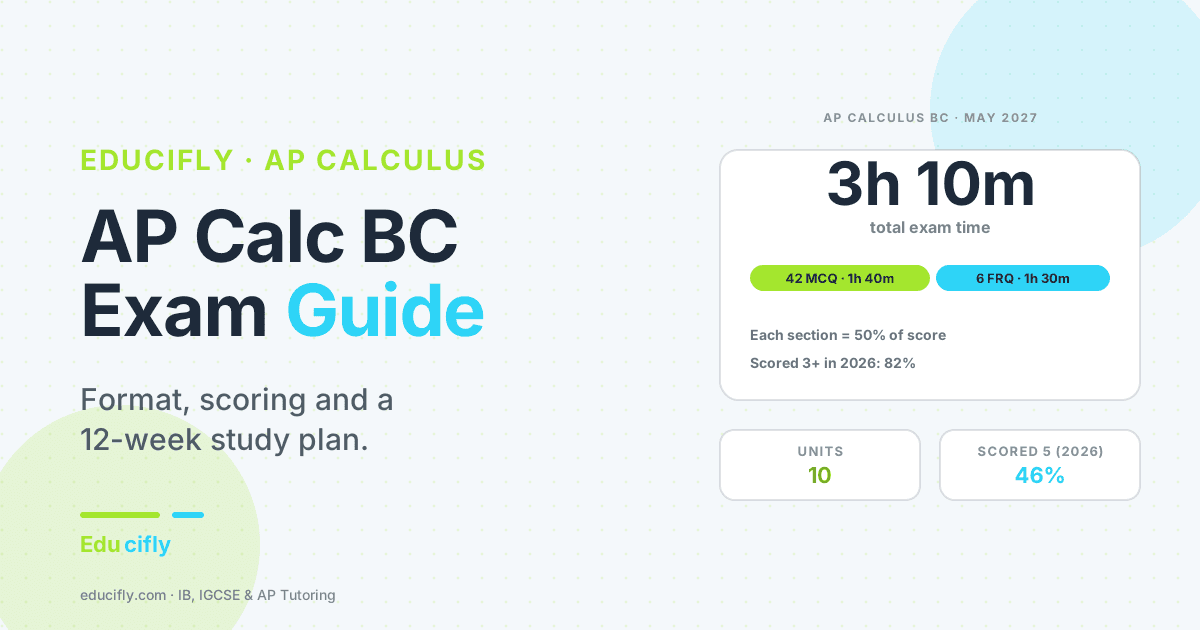
The AP Calculus BC exam is a 3 hour 10 minute test that covers the first two semesters of college calculus. In May 2027 it takes place on Monday 10 May, in the morning session. It has 42 multiple-choice questions (1 hour 40 minutes) and 6 free-response questions (1 hour 30 minutes). Each section counts for 50% of the score. Some parts allow a graphing calculator and some don't. Scores run from 1 to 5. In 2026, 82% of students scored a 3 or higher and 46% scored a 5. The exam is "hybrid digital": students read questions in an app called Bluebook, but they write their free-response answers by hand in a paper booklet.
AP stands for Advanced Placement. These are college-level courses taught in high school. Each one ends with a College Board exam, and a strong score can earn college credit or let a student skip an intro course.
AP Calculus BC exam at a glance
The exam has two sections, each worth half your score, and each split into a no-calculator part and a calculator part. Here is the whole structure in one table.
Feature | Details for May 2027 |
|---|---|
Date | Monday 10 May 2027, Session 1 (morning) |
Total time | 3 hours 10 minutes |
Format | Hybrid digital: Bluebook app plus a paper booklet for written answers |
Section I | 42 multiple-choice questions, 1 hr 40 min, 50% of score |
Section II | 6 free-response questions, 1 hr 30 min, 50% of score |
Calculator | Graphing calculator needed for Section I Part B and Section II Part A only |
Score scale | 1 to 5 |
Exam fee (2027) | $99 in the US, $129 outside the US |
The start time depends on the school's time zone, so your child's school will confirm it. The College Board lists the day and session, and the school sets the details.
How long is the AP Calculus BC exam?
The AP Calculus BC exam takes 3 hours 10 minutes of testing time. That is 1 hour 40 minutes for multiple choice and 1 hour 30 minutes for free response. Add check-in, instructions and the short break between sections, and the whole morning runs longer than that.
Many guides online still say the multiple-choice section has 45 questions and runs 1 hour 45 minutes. That was the older format. The College Board changed the number of questions and the timing for May 2027, so be careful with older books and websites. If a practice test has 45 questions, it's built on the old pattern.
Section by section: what each part looks like
The exam is built from four parts, and the calculator rule changes from one part to the next. This table shows each part, how many questions it has, how long it lasts and how much it is worth.
Part | Questions | Time | Calculator? | Share of score |
|---|---|---|---|---|
Section I, Part A (multiple choice) | 29 | 62 minutes | No | 35% |
Section I, Part B (multiple choice) | 13 | 38 minutes | Graphing calculator required | 15% |
Section II, Part A (free response) | 2 | 30 minutes | Graphing calculator required | 16.7% |
Section II, Part B (free response) | 4 | 60 minutes | No | 33.3% |
Notice something useful here. The no-calculator parts are worth about 68% of the whole exam (35% plus 33.3%). So the calculator is a helper, not the main tool. Students who rely on it do badly. Students who know the algebra and the ideas do well.
Section I, Part A: 29 questions, no calculator
Part A is the biggest single block. It has 29 multiple-choice questions in 62 minutes, which is about 2 minutes 8 seconds per question. There is no calculator, so every answer comes from knowing the rules and doing clean algebra by hand.
Questions can use formulas, graphs, tables or words. A question might show a table of values and ask for an average rate of change. The next might give a graph of a derivative and ask where the original function has a maximum.
Section I, Part B: 13 questions, calculator needed
Part B has 13 multiple-choice questions in 38 minutes, which is about 2 minutes 55 seconds each. The extra time per question is there because these questions are often longer and need the graphing calculator.
Typical calculator jobs include finding where two graphs cross, working out a definite integral, finding a numerical derivative at a point, and solving an equation that has no neat algebra answer.
Section II, Part A: 2 free-response questions, calculator needed
Part A of the free-response section has 2 questions in 30 minutes. That is 15 minutes each. These are usually word problems with a real-world story, like water flowing into a tank or a car moving along a road. Your child needs to set up an integral or a derivative, use the calculator to evaluate it, and then explain the answer in a sentence.
Section II, Part B: 4 free-response questions, no calculator
Part B has 4 questions in 60 minutes, again 15 minutes each. No calculator is allowed. This is where the BC-only topics tend to show up, like series, parametric equations, polar curves and vector motion. It is also where the heavy algebra lives.
What's the same, and what's different, in a digital exam?
The exam is "hybrid digital", which means questions are on a screen but written answers are on paper. Here is how it works in practice.
Students open the Bluebook app on a school device or their own laptop or tablet.
Multiple-choice questions and free-response prompts appear in Bluebook.
Students handwrite their free-response answers in a paper booklet, which is sent back to the College Board for scoring.
A sample free-response booklet is available, so students can see what the paper looks like before exam day.
Students can take practice tests inside Bluebook to get used to the screen.
This matters for one practical reason. Graders read handwriting. A student who rushes and writes small, messy work can lose points that a neat student keeps.
The calculator rules, in plain English
Your child needs a graphing calculator for two of the four parts, and the rules are strict. Here is what the College Board policy says.
A graphing calculator is required for Section I Part B and Section II Part A. No calculator is allowed on the other two parts.
Students can use the built-in Desmos calculator inside Bluebook. The College Board says only the built-in version can be used during the exam. The web and phone versions of Desmos are not allowed.
Students can also bring up to 2 approved handheld calculators, in addition to Desmos.
Approved brands include Texas Instruments, Casio, Hewlett-Packard, Sharp, Radio Shack and a few others on the official list. The list is on the College Board site.
Calculators with a typewriter-style keypad, pen input, wireless or Bluetooth, internet access, a camera, or a stylus are not allowed.
Students can't share a calculator with another student.
Students don't have to clear their calculator memory before or after the exam. But using memory to take exam material out of the room cancels the score.
Our advice: pick one calculator early in the year and use it for every homework set. Fumbling with unfamiliar buttons costs more time than any single hard question.
What topics does the exam test?
The exam covers 10 units, and two of them are only in BC. The College Board gives each unit a weighting range for the multiple-choice section. The table below shows the ranges and our plain-English notes on each unit.
Unit | Topic | Multiple-choice weight | In plain English |
|---|---|---|---|
1 | Limits and continuity | 5%–10% | What happens to a function as x gets close to a number |
2 | Differentiation: definition and fundamental properties | 5%–10% | The derivative from first principles, and the basic rules |
3 | Differentiation: composite, implicit and inverse functions | 5%–10% | The chain rule and its relatives |
4 | Contextual applications of differentiation | 5%–10% | Rates of change in real stories, related rates, L'Hôpital's rule |
5 | Analytical applications of differentiation | 10%–15% | Maximums, minimums, graph shape, the mean value theorem |
6 | Integration and accumulation of change | 15%–20% | Areas, Riemann sums, the fundamental theorem, new integration methods |
7 | Differential equations | 5%–10% | Equations that involve a derivative, slope fields, growth models |
8 | Applications of integration | 5%–10% | Area between curves, volume, average value, arc length |
9 | Parametric equations, polar coordinates and vector-valued functions | 10%–15% | Curves described by a time variable, and motion in a plane |
10 | Infinite sequences and series | 15%–20% | Adding endless lists of numbers, Taylor series, convergence tests |
Look at where the weight sits. Unit 6 (integration) and Unit 10 (series) are the two heaviest, each worth 15%–20% of the multiple-choice questions. Together with Unit 9, the BC-only units can make up about 25% to 35% of Section I. Units 9 and 10 are the new ground for students who took AB, or who are coming straight into BC.
Our guide to AP Calculus AB vs BC lays out exactly which topics BC adds on top of AB.
The skills behind the topics
The exam also tests four "mathematical practices". The College Board gives each one a weighting.
Practice | Multiple choice | Free response |
|---|---|---|
Use procedures and rules to find expressions and values | 50%–70% | 35%–60% |
Move between representations (graph, table, formula, words) | 15%–30% | 10%–20% |
Justify reasoning and solutions | 10%–20% | 35%–60% |
Use correct notation, language and conventions | Not assessed | 10%–25% |
The big lesson sits in that table. On multiple choice, the exam is mostly about getting the right answer with the right method. On free response, justifying your reasoning is worth 35%–60%, and using correct notation is worth another 10%–25%. A student who gets the right number but writes no reason and sloppy notation can lose a big share of the marks.
How the AP Calculus BC exam is scored
Your child's multiple-choice and free-response scores are added together and then turned into a score from 1 to 5. Here is the process, step by step.
1. Multiple choice: Each correct answer earns a point. There is no penalty for a wrong answer, so a student should never leave a question blank.
2. Free response: Each of the 6 questions is marked out of 9, so the section is out of 54.
3. Weighting: The multiple-choice raw score (out of 42) is scaled up so that it counts for the same share as free response. Unofficial calculators scale it to 54 by multiplying the number correct by 54/42.
4. Composite score: The two parts are added, giving a composite score out of 108.
5. Conversion: The College Board turns the composite score into a 1-to-5 AP score.
The most important point is the last one. The College Board does not publish fixed cutoffs. The conversion is adjusted each year for how hard that year's exam was. A raw score that earns a 5 one year might earn a 4 the next. Students never see their composite score, only the final 1-to-5 number.
What score do you need? An unofficial guide
Some free score calculators estimate the cutoffs from past years. Their rough numbers are shown below. They are not from the College Board, and the real cutoffs will differ a little in any given year, so treat this as a guide only.
AP score | Meaning (College Board label) | Rough composite out of 108 |
|---|---|---|
5 | Extremely well qualified | About 68 and above |
4 | Well qualified | About 56 to 67 |
3 | Qualified | About 42 to 55 |
2 | Possibly qualified | About 35 to 41 |
1 | No recommendation | Below about 35 |
Here is the part that surprises parents. A 5 needs roughly two-thirds of the points, not 90%. A student who scores 70 out of 108 can earn the top score. That means perfection is not the goal. Steady, careful marks on every question are.
The AB subscore
BC students also get an AB subscore on their score report. It shows how they did on the AB-level topics inside the BC exam. It works as a safety net. A student who has a rough day on the series questions can still show strong AB-level skills, which some colleges accept for credit.
How students have scored: six years of results
AP Calculus BC has one of the highest pass rates of any AP exam, and about four in five students score a 3 or higher. The table below shows the College Board's official results.
Year | Scored 5 | Scored 4 | Scored 3 | Scored 2 | Scored 1 | 3 or higher | Students |
|---|---|---|---|---|---|---|---|
2026 | 46% | 22% | 14% | 14% | 4% | 82% | About 171,000 |
2025 | 44.0% | 21.9% | 12.8% | 15.2% | 6.2% | 78.6% | 160,436 |
2024 | 47.7% | 21.1% | 12.1% | 13.9% | 5.2% | 80.9% | 148,191 |
2023 | 43.5% | 15.9% | 19.0% | 15.2% | 6.3% | 78.5% | 135,458 |
2022 | 41.2% | 15.6% | 20.1% | 16.4% | 6.8% | 76.9% | 120,238 |
2021 | 38.3% | 16.5% | 20.4% | 18.2% | 6.6% | 75.2% | 124,599 |
Three things stand out.
First, the share of 5s sits between 38% and 48%. That is very high for an AP exam. Second, the number of test-takers has grown by more than a third since 2021. Third, the pass rate moves only a few points from year to year, so there is no sign of a sudden change.
Does that mean the exam is easy? No. Students who choose BC are mostly the strongest math students in their school. They are a self-selected group, so their results look better than the average AP student's. We explain this in more detail in our guide on whether AP Calculus AB is hard, which uses the same effect for AB.
How much time do you get per question?
The pace is steady but not rushed, at about 2 to 3 minutes per multiple-choice question and 15 minutes per free-response question. Here is the maths.
Part | Questions | Time | Average per question |
|---|---|---|---|
Section I, Part A | 29 | 62 min | About 2 min 8 sec |
Section I, Part B | 13 | 38 min | About 2 min 55 sec |
Section II, Part A | 2 | 30 min | 15 min |
Section II, Part B | 4 | 60 min | 15 min |
These are averages. Some questions take 30 seconds and others take 5 minutes. The skill is to move on fast when you're stuck and come back later. A student who spends 6 minutes on one multiple-choice question has just given up three others.
The BC-only topics that trip students up
Most lost marks on the BC exam come from series, parametric and polar questions, plus sloppy justification. Here are the areas worth extra time.
Series (Unit 10)
Series is the heaviest BC-only unit, at 15%–20% of the multiple-choice section. Students need to know how to test whether a series converges, how to build a Taylor or Maclaurin polynomial, and how to bound the error of an approximation. The most common mistake is mixing up the tests. Make a one-page chart of each test, when to use it and what a correct conclusion sounds like.
Parametric, polar and vector functions (Unit 9)
This unit has its own formulas for slope, speed, arc length and area. Many students know the formulas but forget which one fits the question. Drill the "what is it asking for?" step before the calculation.
New integration methods (Unit 6)
BC adds integration by parts, partial fractions and improper integrals. These are mostly about practice. Do 5 of each type every week until the steps feel automatic.
Differential equations (Unit 7)
BC includes Euler's method and logistic growth models on top of the AB material. Euler's method is a step-by-step estimate, so it's easy points once students slow down and write each step.
Writing the justification
A free-response answer needs a reason, not just a number. If a question asks, "Is the function increasing at t = 3?", the answer is not "yes". It's "Yes, because f′(3) = 4, which is greater than 0." Students should practise writing one clear sentence like that for every "justify" question.
A 12-week study plan for the AP Calculus BC exam
Twelve weeks is enough time for a student who already knows the course content to get exam-ready. This is Educifly's own suggested plan, not an official one. Adjust it if your school has covered the units in a different order.
Weeks | Focus | What to do |
|---|---|---|
1–2 | Diagnose | Take a full practice exam under timed conditions. Mark it using the official scoring guide. List weak units. |
3–4 | Foundations | Rebuild limits, derivatives and the chain rule. Do 20 mixed derivative problems and 20 mixed integral problems each week. |
5–6 | Integration | Practise integration by parts, partial fractions, improper integrals and area/volume problems. |
7–8 | Series | Learn each convergence test. Build Taylor polynomials. Practise the error bound. |
9 | Parametric, polar, vectors | Work every formula for slope, speed, arc length and area. |
10 | Free response | Do 2 past free-response questions a day. Write full justifications. |
11 | Full exam practice | Take a second full timed exam in Bluebook. Review every error. |
12 | Polish | Light review of the formula sheet you made. Calculator practice. Sleep. |
Past free-response questions and their scoring guidelines are free on the College Board's AP Central site. They are the best practice material there is, because they are the real thing. Use them often.
How to study for each section
Practise each part the way you'll sit it, and keep a log of every mistake. Here is what works best.
For Section I Part A (no calculator)
Do timed sets of 10 questions in 20 minutes with no calculator, even in week 1.
Learn the common values of sine, cosine and tangent, and the main derivative and integral rules, so they come without effort.
Skip any question that stalls you for more than 3 minutes. Circle it and return.
For Section I Part B (calculator)
Practise the four big calculator jobs: graphing, finding intersections, finding a definite integral, and finding a derivative at a point.
Always check that the calculator is in radian mode when the question uses trig functions in calculus.
Round only at the end. The exam asks for answers to three decimal places in many questions.
For Section II (free response)
Write full sentences for every "justify" question.
Show setup lines, such as the integral you wrote before the calculator gave a number. Graders give marks for setup.
Include units on answers that come from real-world stories.
Never cross out work without replacing it. A crossed-out right answer can't earn marks.
The most common mistakes on the exam
Most students lose marks for the same few reasons each year. This table lists them and the fix.
Mistake | Why it costs marks | The fix |
|---|---|---|
Leaving a multiple-choice question blank | There is no penalty for a wrong answer, so a blank is a lost chance | Guess on every question |
Calculator in degree mode | Every trig answer will be wrong | Check the mode before each calculator part |
No justification | Free response gives big marks for reasoning | Write one "because" sentence for every claim |
Rounding too early | Small errors grow through the problem | Keep full digits until the final answer |
Missing "+ C" | A common lost mark on indefinite integrals and differential equations | Write it the second you integrate |
Mixing up series tests | The wrong test gives a wrong conclusion | Keep a one-page test chart and practise it |
Spending too long on one question | Time lost can't be won back | Move on after 3 minutes and return later |
Messy handwriting | Graders can't give marks for what they can't read | Write larger and keep lines straight |
What to do the week before the exam
The last week is for light practice, calculator checks and sleep, not for cramming. Here is a simple checklist.
1. Confirm the date, start time and room with your school.
2. Install and test the Bluebook app, and check that your device is ready.
3. Choose your calculator and test it. Bring a spare, plus fresh batteries if it needs them.
4. Check that your calculator is on the approved list.
5. Do one short practice set a day, 30 to 45 minutes at most.
6. Go through your list of past mistakes one last time.
7. Pack the pens or pencils your school's instructions ask for, and a water bottle if allowed.
8. Go to bed on time the night before.
What score do you need for college credit?
Most colleges give credit for a 4 or 5, and some accept a 3, but every college sets its own rule. There is no national rule. A university might give credit for Calculus I with a 3 and for Calculus I and II with a 5. Another might ask for a 5 and a placement test. Some engineering programmes ask students to retake calculus no matter what the score is.
The only reliable way to know is to look up each college's AP credit policy. Most publish a simple table by exam and score. The College Board has a search tool as well.
If your child is also weighing IB, our guide on IB vs AP compares how colleges treat both.
Should my child take AP Calculus BC at all?
Take BC if your child likes math, learns new ideas quickly and wants two semesters of college credit. Take AB if it's their first real calculus course or their schedule is full. BC is not a harder way of doing the same thing. It covers the same ground as AB and then keeps going.
Students coming from AP Precalculus often wonder if they can jump straight to BC. Some schools allow it, some don't. Our guide to AP Precalculus explains what that course covers and how well it prepares students for calculus.
One more rule from the College Board: a student can't take both the AB and BC exams in the same year. The BC exam already gives an AB subscore, so there's no need to.
Where Educifly's tutors fit in
BC calculus moves fast, and every unit builds on the last. If a student misses limits in September, they'll struggle with series in March.
At Educifly, our AP Math tutors work 1-on-1, online, with the same tutor every week. That matters in calculus, because the tutor learns exactly where your child gets stuck. We teach the units in the order that matches your child's school pace, mark past free-response questions with the official scoring guides, and help students write the justifications that earn marks. Since 2018, we've taught over 500 students across IB, IGCSE and AP.
If you'd like to see how it works, you can book a free trial class. There's no obligation.
FAQ: AP Calculus BC exam
When is the AP Calculus BC exam in 2027?
The AP Calculus BC exam is on Monday 10 May 2027, in Session 1, which is the morning session. The exact start time depends on your school's time zone and set-up. Your school's AP coordinator will confirm the time and room.
How long is the AP Calculus BC exam?
The exam is 3 hours 10 minutes of testing time. Section I (multiple choice) is 1 hour 40 minutes and Section II (free response) is 1 hour 30 minutes. Check-in, instructions and the break between sections add more time on top of that.
How many questions are on the AP Calculus BC exam?
There are 48 questions in total. Section I has 42 multiple-choice questions (29 without a calculator and 13 with one). Section II has 6 free-response questions (2 with a calculator and 4 without). The number of multiple-choice questions changed for May 2027, so older guides may say 45.
Can you use a calculator on the AP Calculus BC exam?
Yes, but only on two of the four parts. A graphing calculator is needed for Section I Part B and Section II Part A. It is not allowed on Section I Part A or Section II Part B. Students can use the built-in Desmos calculator in Bluebook, or bring up to 2 approved handheld calculators.
What is a good score on AP Calculus BC?
A 4 or 5 is a strong score, and a 3 means "qualified". In 2026, 46% of students scored a 5 and 82% scored a 3 or higher. A score of 5 is the target for most students who want college credit at selective universities.
How many points do you need for a 5 on AP Calculus BC?
The College Board doesn't publish fixed cutoffs, and they change each year. Unofficial calculators based on past years suggest about 68 out of 108 for a 5. That is roughly two-thirds of the points, so a student doesn't need a perfect paper.
Is the AP Calculus BC exam hard?
Yes, it's a demanding exam, but most prepared students do well. About four in five students passed in each of the last two years. The hardest parts are usually series, polar and parametric questions, and free-response justification.
Is there a penalty for wrong answers?
No. Wrong answers don't lose points, so students should answer every multiple-choice question. If time is running out, guess on the rest.
Is the AP Calculus BC exam on paper or on a computer?
It's both. The exam is hybrid digital. Students read multiple-choice and free-response questions in the Bluebook app, but they handwrite their free-response answers in a paper booklet, which is then scored.
What's the AB subscore on the BC exam?
The AB subscore is an extra score on a BC score report. It shows how a student did on the topics that are also in AP Calculus AB. It's useful for colleges that give credit for first-semester calculus only.
How should I study for the AP Calculus BC exam?
Start with a timed practice exam to find weak units. Then work through the units in order, spending extra time on integration and series. Do real past free-response questions and mark them with the official scoring guides. Take at least two full timed exams before May. Our 12-week plan above gives a week-by-week outline.
How much does the AP Calculus BC exam cost?
The 2027 exam fee is $99 in the US and $129 outside the US. Students with financial need can get a reduced fee. Check with your school's AP coordinator, since the school collects the fee.