EDUCIFLY BLOG
How the IB Points System Works (+ Calculator)
If your child is in the IB Diploma, you've probably heard numbers thrown around. "She got a 38." "He's predicted a 42." But what do these numbers mean? And how does the IB points system actually add up to that famous score out of 45?
This guide breaks it down in plain English. No jargon. No assumptions. By the end, you'll know exactly how IB diploma points work, how the TOK and Extended Essay bonus points fit in, and how many points your child needs to pass. We'll also show you how to use an IB score calculator to check a score in seconds.
We've coached over 500 IB students since 2018. The points system trips up almost every family at first. Let's fix that.
Quick answer: how the IB points system works
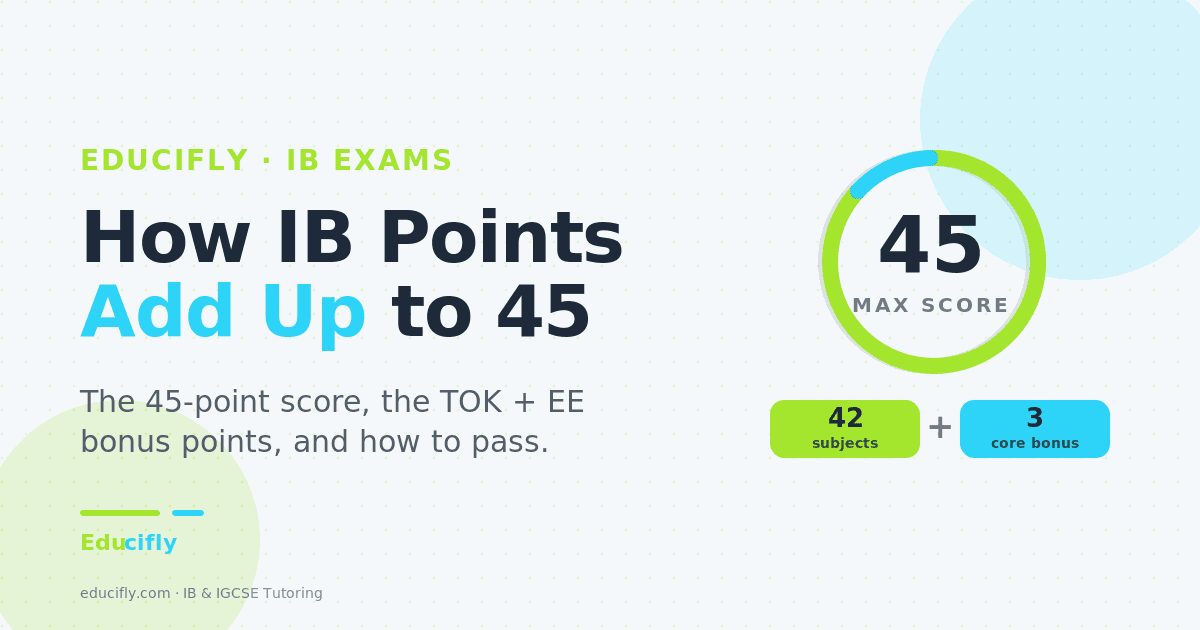
The IB Diploma is scored out of 45 points. Your child takes six subjects. Each subject is graded from 1 to 7, so six subjects give a maximum of 42 points. On top of that, up to 3 bonus points come from two of the core parts — Theory of Knowledge (TOK) and the Extended Essay (EE). That's 42 + 3 = 45. To pass and earn the diploma, a student needs at least 24 points and must meet a short list of conditions. The global average score in 2024 was 30.32.
That's the whole system in one paragraph. Now let's unpack each piece.
What is the IB points system?
The IB points system is the way the International Baccalaureate turns six subject grades plus the core into one final number out of 45.
Think of it like a recipe. You add up grades from each subject. Then you add a few bonus points from the core. The total is your child's IB score.
Here's what makes the IB different from many other exams. It doesn't just measure subjects. It also rewards two big pieces of independent work — a 4,000-word research essay (the EE) and a course about how we know things (TOK). Those two feed the bonus points.
The system is the same everywhere in the world. A 7 in Higher Level Biology in Dubai means the same as a 7 in Biology in London or Singapore. That global standard is a big reason universities trust IB scores.
How the 45 points break down
The 45 points come from two sources: your six subjects and the core.
Here's the full breakdown:
Where points come from | How many | Details |
|---|---|---|
6 subjects | Up to 42 | Each subject scored 1–7. Six subjects × 7 = 42. |
TOK + Extended Essay (the core) | Up to 3 | Bonus points from a grid that combines your TOK and EE grades. |
Total | 45 | The highest score any student can earn. |
A few things parents often miss:
Standard Level (SL) and Higher Level (HL) subjects are worth the same in points. A 7 at SL counts the same as a 7 at HL when adding up the score. The difference is depth and teaching hours, not point value.
The third part of the core — Creativity, Activity, Service (CAS) — does not give points. It is graded as complete or not complete. But it is not optional. If CAS isn't finished, the student doesn't get the diploma, no matter how high the score.
How the 1–7 subject grades work
Each of the six subjects is graded on a scale from 1 to 7, where 7 is the highest.
Here's what each grade roughly means:
Grade | Meaning |
|---|---|
7 | Excellent |
6 | Very good |
5 | Good |
4 | Satisfactory (a solid pass) |
3 | Mediocre |
2 | Poor |
1 | Very poor |
A grade comes from a mix of exams and coursework. The coursework piece is usually the Internal Assessment (IA = a project or report marked partly by the school). The exact split changes by subject. In most subjects, final exams carry the biggest weight, and the IA carries 20–30%.
Each grade sits inside a range of marks called a grade boundary. Boundaries shift a little every exam session, and they decide where a 5 becomes a 6. For the bigger picture on how the whole grading scale works — including how raw marks turn into a 1–7 grade — see our IB scoring system explained post.
IB bonus points: the TOK and EE core matrix
The core gives up to 3 extra points. These IB bonus points come from combining the grade for Theory of Knowledge with the grade for the Extended Essay.
TOK and the EE are each graded with a letter, from A (best) to E (weakest). You then look up both letters on a grid called the core points matrix. Where the two letters meet, that's your bonus points — between 0 and 3.
Here is the official IB core points matrix:
EE grade ↓ / TOK grade → | A | B | C | D | E |
|---|---|---|---|---|---|
A | 3 | 3 | 2 | 2 | Fail |
B | 3 | 2 | 2 | 1 | Fail |
C | 2 | 2 | 1 | 0 | Fail |
D | 2 | 1 | 0 | 0 | Fail |
E | Fail | Fail | Fail | Fail | Fail |
How to read it: find your EE letter down the left. Find your TOK letter across the top. The box where they cross is your bonus points.
Example: a student gets a B in TOK and a C in the Extended Essay. Look up EE row C and TOK column B. That box says 2. So this student earns 2 bonus points.
A few patterns worth knowing:
To get all 3 bonus points, a student needs two strong letters. An A and an A gives 3. An A and a B gives 3. After that it drops fast.
Two weak letters give nothing. A D in TOK and a D in the EE gives 0 points. The work still has to be finished — it just adds no points.
These 3 points matter more than they look. The jump from 38 to 41 can be the gap between two university offers. Many students who reach for a 40+ score win it on the core, not the exams. Strong support on the EE and TOK pays off here. We offer focused Extended Essay help for exactly this reason.
The failing condition you must avoid
Look again at the matrix. Notice the word "Fail" in the bottom row and the last column.
If a student scores an E in either TOK or the Extended Essay, that triggers a failing condition. This means no diploma — even with high subject grades. An N grade (Not submitted) does the same thing.
So the core isn't just about chasing 3 bonus points. It's also a safety check. Never let TOK or the EE slide to an E.
How many points do you need to pass the IB?
To pass the IB Diploma, a student needs at least 24 points out of 45 — plus a list of conditions.
The 24-point minimum is the headline number. But points alone aren't enough. The IB checks the shape of the grades too, so a student can't pass on a few very high scores while failing others.
Here are the full conditions for the diploma, straight from the IB:
CAS requirements are met.
The student has at least 24 total points.
A grade has been awarded in every subject, plus TOK and the EE.
A grade of at least 2 in every subject (no grade 1 anywhere).
No more than two grade 2s (SL or HL combined).
No more than three grade 3s or below (SL or HL combined).
At least 12 points across the HL subjects. (If a student takes four HL subjects, the three best count.)
At least 9 points across the SL subjects. (For students with two SL subjects, at least 5 points across those two.)
No E grade in TOK or the EE.
That's a lot of rules. Here's the simple version: get a 24, keep every subject at a 3 or above where you can, and don't bomb your HLs. Hit those and the rest usually takes care of itself.
What counts as a failing condition?
A student does not get the diploma if any of these happen:
Total below 24 points.
A grade 1 in any subject.
More than two grade 2s.
More than three grades of 3 or below.
Fewer than 12 points across HL subjects.
Fewer than 9 points across SL subjects.
An E in TOK or the EE.
CAS not completed.
A student who narrowly misses can sometimes retake. The school's IB coordinator manages that process.
How to use an IB score calculator
An IB score calculator adds up the six subject grades and the core bonus points for you, so you see the final number out of 45 in seconds.
Doing the maths by hand is easy to get wrong, especially the core matrix. A good calculator removes the guesswork. Here's how to use one:
Enter each subject grade. Type in the 1–7 grade for all six subjects. Mark which are HL and which are SL.
Add the TOK and EE grades. Pick the letter (A–E) for each. The calculator applies the core matrix for you.
Read the total. You'll see the score out of 45, plus the bonus points the core added.
Check the pass conditions. A strong calculator also flags whether the grade pattern meets the diploma rules — not just the 24-point line.
Try our free IB Score Calculator. Drop in your child's grades — real or predicted — and see the full score breakdown right away. It's the fastest way to test "what if" scenarios before results day.
Worked example: calculating a real IB score
Let's walk through a full score, step by step, the way the calculator does it.
Meet Aisha. Here are her grades:
Subject | Level | Grade |
|---|---|---|
English Literature | HL | 6 |
Spanish B | SL | 5 |
History | HL | 6 |
Biology | HL | 5 |
Mathematics AA | SL | 7 |
Visual Arts | SL | 5 |
Step 1 — add the subjects: 6 + 5 + 6 + 5 + 7 + 5 = 34 points.
Step 2 — the core. Aisha got a B in TOK and an A in the EE. Look up EE row A, TOK column B on the matrix. That's 3 bonus points.
Step 3 — add them: 34 + 3 = 37 points.
Step 4 — check the conditions. Her HL points are 6 + 6 + 5 = 17 (needs 12 ✓). Her SL points are 5 + 7 + 5 = 17 (needs 9 ✓). No grade below 5. CAS complete. No E in the core. She passes comfortably, with a strong 37.
See how the core lifted her from 34 to 37? That's three subjects' worth of value from two pieces of writing. This is why we tell families never to treat TOK and the EE as afterthoughts.
What is a good IB score?
A "good" IB score depends on the goal, but here are the real numbers to judge against.
The global average in 2024 was 30.32 points. The overall pass rate was 80.5%. So a score in the low 30s is right around the world average.
Here's a rough guide:
Score range | How to read it |
|---|---|
24–29 | A pass. Opens many university doors. |
30–34 | Around to above the global average. Solid. |
35–39 | Strong. Competitive for good universities worldwide. |
40–44 | Excellent. Top universities, including many in the UK and US. |
45 | Perfect score. Very rare. |
For context, only about 9.3% of students scored in the 40–45 band in 2024. A 45 is rare enough that the IB no longer even publishes how many students reach it.
If your child is aiming high, our guide on how to score a 7 in IB breaks down what top grades actually take, subject by subject.
How to add points to your IB score
Most students leave points on the table in three places: the core, the IAs, and one or two "weak" subjects. Each is fixable.
Win the core. Three bonus points are sitting right there. Getting an A or B in both TOK and the EE is very doable with early planning. Start the EE in Year 12, not the night before. Don't treat TOK as a free period.
Polish the IAs. The Internal Assessment is worth 20–30% of most subjects, and it's marked over weeks, not in one stressful exam. That makes it the most controllable marks in the whole diploma. Pick a focused topic, follow the rubric, and edit hard.
Lift your weakest subject by one grade. Going from a 4 to a 5 in one subject is one whole point. It's often easier than squeezing a 6 into a 7. Target the subject with the most room to grow. For many students that's Math, where steady weekly practice moves grades fast — our IB Math tutors focus on exactly this.
Small, planned gains add up. A point on the core, a point from a better IA, and a point from a lifted subject is three points. That can move a 35 into a 38.
Common myths about IB points
Let's clear up the mix-ups we hear most often from parents.
Myth: HL subjects are worth more points than SL. False. A 7 is a 7. SL and HL count equally toward the score. HL is harder and deeper, but each grade is worth the same number of points.
Myth: CAS gives you points. False. CAS is pass/fail. It gives zero points but is still required to pass.
Myth: You only need 24 points to be safe. Not quite. You also need the right grade pattern — enough HL points, no grade 1s, no E in the core. The 24 is necessary but not the whole story.
Myth: The core points are too small to matter. False. Three points is the difference between a 39 and a 42. At the top end, that's the difference between offers.
Frequently asked questions
What is the maximum IB score?
The maximum IB score is 45 points. It comes from six subjects worth up to 42 points (six subjects, each graded 1–7), plus up to 3 bonus points from the core — Theory of Knowledge and the Extended Essay combined. A perfect 45 is very rare.
How many points do you need to pass the IB Diploma?
You need at least 24 points out of 45, plus a list of conditions. These include completing CAS, getting at least a grade 2 in every subject, scoring at least 12 points across your HL subjects and 9 across your SL subjects, and avoiding an E grade in TOK or the Extended Essay.
How do the TOK and EE bonus points work?
Theory of Knowledge and the Extended Essay are each graded A to E. You combine the two letters on the IB core points matrix to get between 0 and 3 bonus points. Two strong grades (like A and A, or A and B) give the full 3 points. An E in either one is a failing condition that blocks the diploma.
Are HL subjects worth more points than SL?
No. Higher Level (HL) and Standard Level (SL) subjects are worth the same in points. A 7 at SL counts exactly the same as a 7 at HL toward your total score. HL involves more depth and teaching hours, but the point value per grade is identical.
Does CAS give you IB points?
No. Creativity, Activity, Service (CAS) does not give any points. It's marked as complete or not complete. But CAS is required — if a student doesn't finish it, they won't receive the diploma, no matter how high their score.
What is the average IB score?
The global average IB score in the May 2024 session was 30.32 points. The overall pass rate was about 80.5%. A score in the low 30s sits right around the worldwide average.
What is a good IB score for university?
A score of 24–29 passes and opens many doors. 30–34 is around or above the global average. 35–39 is strong and competitive for good universities. 40 and above is excellent and targets the most selective universities. Only about 9% of students score 40 or higher.
Can you fail the IB even with 24 points?
Yes. The 24-point minimum is necessary but not enough on its own. You can still fail if you have a grade 1 in any subject, more than two grade 2s, too few HL or SL points, an E in TOK or the EE, or incomplete CAS. The grade pattern matters as much as the total.
How is the IB score calculated?
Add the 1–7 grades from all six subjects (up to 42 points). Then add the core bonus points from the TOK and EE matrix (0–3 points). The total is your score out of 45. The fastest way to do this accurately is with an IB score calculator, which applies the matrix and checks the pass conditions for you.
How rare is a 45 in the IB?
A perfect 45 is very rare. Since 2023, the IB no longer publishes the exact number of students who reach 45, to discourage student comparisons. For context, fewer than 1 in 10 students score even 40 or above.
How can I improve my IB score?
Focus on three areas: win the core (aim for A or B in both TOK and the EE for the full 3 bonus points), polish your Internal Assessments (worth 20–30% of most subjects and marked over weeks), and lift your weakest subject by one grade. Small planned gains across all three can move a score up by several points.
Where can I check my child's IB score?
You can estimate it any time with a free IB score calculator. Enter the six subject grades and the TOK and EE letters, and it returns the score out of 45 with the core points worked out. Official results are released by the IB through your school on results day. If you'd like a tutor to review predicted grades and build a plan, book a free trial class.