EDUCIFLY BLOG
How the IB Scoring System Works: The 45-Point IB Diploma Explained (2026)
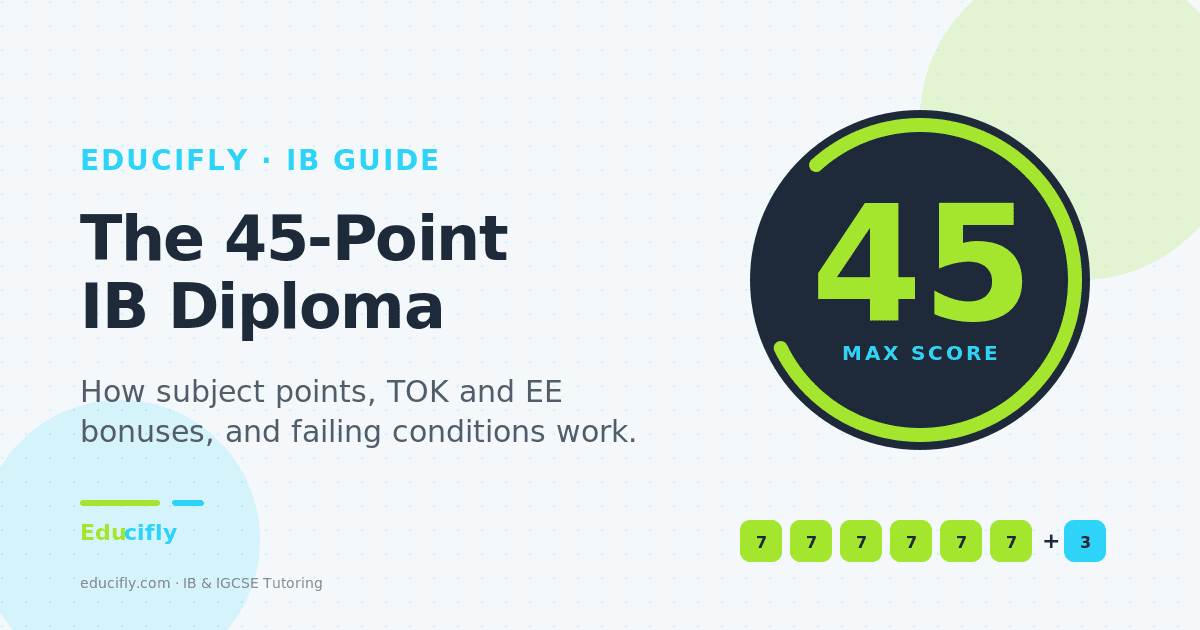
The IB Diploma is graded out of 45 points. That single number drives university admissions decisions at thousands of institutions worldwide, sometimes within a single point. Yet most parents new to the IB don’t know how those 45 points are actually constructed — what each subject is worth, where the bonus points come from, what counts as “good”, and what the IB’s failing conditions are.
This guide explains the IB scoring system end to end, with a worked example, the official failing conditions, and a comparison of IB scores to A-Level, AP, and other systems. If you want to model a target score quickly, Educifly’s free IB Score Calculator does that in 30 seconds. Check when IB results are released so the dates don’t catch you out.
Quick answer: how is the IB Diploma scored out of 45?
The IB Diploma is scored on a scale of 24 (minimum pass) to 45 (maximum). The 45 points are built from:
42 points from six subjects — each subject scored 1 to 7, multiplied by six.
3 bonus points from the Core — earned through the combination of the Extended Essay (EE) and the Theory of Knowledge (TOK) grades.
To be awarded the IB Diploma, students must: - Score at least 24 points total - Pass TOK, EE, and CAS (Creativity, Activity, Service) - Avoid certain “failing conditions” (explained below)
A score of 45/45 is achieved by approximately 0.2–0.3% of IB candidates worldwide each session.
The six IB subject groups — what your child must take
Every IB Diploma student takes six subjects, drawn from six “groups”. This requirement is what makes the IB structurally different from A-Levels (typically three or four chosen subjects) or AP (entirely flexible).
Group | Subjects (examples) | Required? |
|---|---|---|
1 — Studies in Language and Literature | English A: Language & Literature, English A: Literature, Spanish A, Hindi A | Yes (1 subject) |
2 — Language Acquisition | English B, Spanish B, French B, Mandarin B, ab initio languages | Yes (1 subject) |
3 — Individuals and Societies | Economics, History, Geography, Psychology, Business Management, Global Politics | Yes (1 subject) |
4 — Sciences | Biology, Chemistry, Physics, Computer Science, Design Technology, Sports Science | Yes (1 subject) |
5 — Mathematics | Math AA (HL/SL), Math AI (HL/SL) | Yes (1 subject) |
6 — The Arts (or a second subject from Groups 1–5) | Visual Arts, Music, Theatre, Film, or a second subject from another group | Yes (1 subject) |
Three of these six subjects must be at Higher Level (HL) and three at Standard Level (SL). Many students take four HLs and two SLs — this is allowed but increases workload significantly.
How each IB subject is scored (1 to 7)
Each of the six subjects is graded on a 1 to 7 scale:
Grade | Approximate meaning | UK A-Level equivalent (rough) |
|---|---|---|
7 | Excellent | A* |
6 | Very good | A |
5 | Good | B |
4 | Satisfactory | C |
3 | Mediocre | D |
2 | Poor | E |
1 | Very poor | U |
A 7 means the student has met every criterion at the highest level. A 4 is a competent pass. A 3 in a subject is usually a failing condition for the Diploma (more on this below).
The 1–7 grade in each subject is built from two components: the external exam papers (sat in May or November) and the Internal Assessment (IA) for that subject. The split varies by course — most subjects are roughly 80% exam / 20% IA, with some Business Management and Psychology courses at 70% / 30%.
For details on the IA component, see Educifly’s guide on how to write an IB Internal Assessment.
The IB Core — TOK, EE, and CAS
In addition to the six subjects, IB Diploma students complete the Core: three components that wrap around the subjects and contribute to the bonus points.
Theory of Knowledge (TOK)
A philosophical inquiry course assessed via a 1,600-word essay (external assessment) and an exhibition of three real-world objects with commentary (internal assessment). TOK is graded A, B, C, D, or E. (For a full walkthrough, see Educifly’s guide on writing a TOK essay.)
Extended Essay (EE)
A 4,000-word independent research paper in one of the IB subjects. Graded A, B, C, D, or E by an external IB examiner. (For more detail, see Educifly’s guide on Extended Essay topics.)
Creativity, Activity, Service (CAS)
A non-graded portfolio of co-curricular engagement across creativity, physical activity, and community service. Pass / Fail. Failing CAS means failing the entire Diploma — but it’s rare for a working student to fail CAS, because the bar is “consistent engagement”, not a specific output.
The TOK + EE bonus point matrix
The Extended Essay and TOK are graded A to E, but they don’t directly add to your 42 subject points. Instead, the combination of your two grades earns 0–3 bonus points according to a published matrix.
TOK Grade ↓ / EE Grade → | A | B | C | D | E |
|---|---|---|---|---|---|
*A* | 3 | 3 | 2 | 2 | Fail |
B | 3 | 2 | 2 | 1 | Fail |
C | 2 | 2 | 1 | 0 | Fail |
D | 2 | 1 | 0 | 0 | Fail |
E | Fail | Fail | Fail | Fail | Fail |
Key takeaway: any E grade in either TOK or EE is a failing condition for the entire IB Diploma — regardless of total points. This is why protecting against an E is more important than chasing an A for some students.
The maximum bonus is 3 points (achieved by an A in TOK + A in EE, or A + B in either order). These 3 points are why a 45 is the maximum total: 6 subjects × 7 = 42, plus 3 bonus points = 45.
A worked example: how a student scores 41/45
Let’s walk through a realistic strong score.
Imagine a Year 13 student taking:
English A: Language & Literature HL — final grade 6
Spanish B HL — final grade 5
History HL — final grade 7
Biology SL — final grade 6
Math AA SL — final grade 7
Visual Arts SL — final grade 5
Subject points: 6 + 5 + 7 + 6 + 7 + 5 = 36
TOK: B Extended Essay: *A* (in History)
Bonus points (from the matrix): 3
Final IB Diploma score: 36 + 3 = 39/45
This would be a competitive score for entry to Oxford, Cambridge, the LSE, and most Ivy League institutions for many courses — though specific course requirements may also include subject-specific grade conditions (e.g. “7 in HL Mathematics”).
For more interactive modelling of your own combinations, the IB Score Calculator lets you plug in subject grades and see your projected score.
What is a good IB score?
This is the most-asked IB question by parents. Here’s an honest, internationally calibrated answer.
IB score | What it means |
|---|---|
45 | Perfect — top 0.2–0.3% globally |
42–44 | Exceptional — top ~3% of IB candidates globally |
38–41 | Strong — competitive for most top-tier global universities |
36–37 | Solid — opens most reputable global universities |
32–35 | Good — broad university options |
28–31 | Decent — many universities, including some competitive ones |
24–27 | Pass — Diploma awarded, narrower university options |
Below 24 | Fail — Diploma not awarded |
The IB’s published global average score has hovered around 30–31 in recent sessions. A score of 36 or above places a candidate in roughly the top 30% globally. A 40 or above places a candidate in roughly the top 10% globally.
What scores top universities expect
Oxford / Cambridge — typical IB offers for most undergraduate courses are 38–42 (with HL grade conditions, often 7,6,6 or 7,7,6 in three HLs).
Imperial College London / LSE — typical offers 38–42, often with specific HL grades (e.g., 7 in HL Mathematics for engineering, 7 in HL Economics for Econ).
Ivy League US universities — IB students with 40+ scores are competitive at all eight Ivies. There is no published “IB requirement” because the US admissions process is holistic.
Top European technical universities (ETH, EPFL, TU Delft) — IB scores in the 38–42 range with strong HL Math and Physics grades.
Top Indian universities (Ashoka, IIT, BITS Pilani) — varies; IB scores of 36+ are competitive.
Top Singapore universities (NUS, NTU, SMU) — IB scores in the 38–42 range, with course-specific HL grade conditions.
Top Hong Kong universities (HKU, HKUST, CUHK) — comparable to Singapore.
Top Australian universities (Melbourne, Sydney, ANU) — IB scores of 38–40+ for competitive courses; published rank conversions are available on each university’s site.
IB Diploma failing conditions
A student can score 28 points and still fail the Diploma if they trigger a failing condition. The IB publishes these explicitly. The Diploma will not be awarded if a candidate has:
Fewer than 24 total points.
A grade of E in TOK or the Extended Essay.
A grade of 1 in any subject.
More than three grades of 2 (HL or SL combined).
More than four grades of 3 or below (HL or SL combined).
An HL total of fewer than 12 points.
An SL total of fewer than 9 points. (Or 8, if the student is registered for four HLs.)
A failing CAS portfolio.
These conditions exist to ensure the Diploma represents balanced, broad performance across subjects. They are why protecting weak subjects matters more than maximising strong ones.
How to convert IB scores to other systems
There is no single official conversion table, but the following rough equivalences are widely recognised for university admissions purposes.
IB to UK UCAS Tariff points (2026 cycle)
IB total | UCAS Tariff points |
|---|---|
45 | 224 |
42 | 200 |
40 | 184 |
38 | 168 |
36 | 152 |
32 | 120 |
28 | 88 |
24 | 56 |
(UCAS uses a Tariff system that converts grades from multiple international qualifications into a common point system for university admissions.)
IB to A-Level (rough offer equivalence)
IB total | A-Level offer equivalent |
|---|---|
42–45 | A*A*A* |
38–41 | A*AA – AAA |
36–37 | AAB |
32–35 | ABB |
28–31 | BBB |
IB to AP (no direct conversion, but indicative)
The IB and AP are structurally different systems and don’t convert cleanly. Many US universities give credit for HL IB scores of 5+ at the same rate as a 4 or 5 on the corresponding AP exam. Specific credit policies vary by university.
IB to Indian Boards (CBSE / ICSE percentages)
Indian universities increasingly accept IB scores directly. A rough equivalence used by some Indian universities:
IB total | CBSE/ICSE percentage equivalent |
|---|---|
42+ | 95%+ |
38 | 90% |
32 | 80% |
28 | 70% |
These are rough; always check the published policy of the specific university.
How the IB is examined
Most IB subjects are examined in May (the larger session) or November (the smaller session, primarily for Southern Hemisphere schools). Exams typically run over a 3-week window.
Each subject has 2 or 3 papers: - Paper 1 is usually a short-answer or multiple-choice paper. - Paper 2 is usually an extended-response paper. - Paper 3 (HL only in some subjects) tests problem-solving and synthesis.
The exam-paper raw marks are converted to a 1–7 grade using grade boundaries set by the IB after the session. Grade boundaries shift session by session based on cohort performance and paper difficulty — a 7 in May 2024 may have required 75% raw marks, while a 7 in May 2025 may have required 78%.
For a complete strategy for hitting 7s, see Educifly’s playbook on how to score a 7 in IB.
How Educifly helps students maximise their IB score
The most reliable way to lift an IB score is 1-on-1 specialist tutoring combined with structured IA and EE coaching. Educifly is a boutique online tutoring practice built specifically for the IB Diploma — our average student lifts 1.4 grade bands across their subjects over the course of a programme.
A typical Educifly IB programme includes:
Hand-matched 1-on-1 tutoring with a subject specialist (former IB examiner or international-school teacher)
Personalised syllabus mastery checklist
Past-paper and mark-scheme drills
IA topic selection, methodology, drafting, and final review
Extended Essay coaching where requested
Regular parent updates
Book a free 30-minute trial class with an Educifly IB specialist in any subject. No card. No commitment.
FAQ — IB Scoring System
What is the highest possible IB score?
45 points — earned from 7 in all six subjects (42 points) plus 3 bonus points from a top combination of TOK and EE grades.
What is the minimum passing IB score?
24 points, provided the student also meets the failing-condition rules (no E in TOK or EE, no grade of 1 in any subject, no more than three grades of 2, etc.).
What is the average IB score worldwide?
The IB publishes its global average annually. It has hovered around 30–31 in recent sessions, with some session-to-session variation. The average for the May 2023 session was 30.24; for May 2024 it was 30.32.
Are HL grades worth more than SL grades?
No — both HL and SL grades are scored on the same 1–7 scale and contribute the same points to the total. However, HL grades are required by universities for specific course prerequisites (e.g., “7 in HL Mathematics” for engineering), so they carry more weight in admissions decisions for STEM courses.
How many bonus points can I earn from TOK and EE?
Up to 3 bonus points, awarded through a published matrix that combines your TOK grade (A–E) and EE grade (A–E). The maximum 3 points requires an A in both, or A + B in either order.
What’s a good IB score for Oxbridge?
Most Oxbridge IB offers fall in the 38–42 range, with specific HL grade conditions for each course (typically 7,6,6 or 7,7,6 in three HLs).
What’s a good IB score for Ivy League universities?
There is no published threshold. IB students with scores of 40 or above are competitive at all eight Ivies, though the US admissions process is holistic — essays, extracurriculars, and recommendations weigh heavily alongside the IB score.
Can I retake the IB Diploma?
Yes. The IB allows resits of individual subjects (and the entire Diploma) in subsequent sessions. Most universities will consider the higher of two scores, though some require the original session’s score.
Does the IB score include CAS?
No — CAS is graded Pass/Fail and does not contribute points to the total. Failing CAS, however, is a Diploma-failing condition.
How is the IB different from the IB Career-related Programme (IBCP)?
The IBCP is a separate, more vocationally focused IB qualification. It uses different grading and is structured differently from the full IB Diploma. Universities recognise the IBCP, but admissions criteria are typically different from the Diploma.
Want to model your child’s projected IB score and identify where the biggest grade lifts are possible? Try Educifly’s free IB Score Calculator or book a free trial class with an Educifly IB specialist.