EDUCIFLY BLOG
IGCSE Cambridge vs Edexcel: A Complete 2026 Comparison
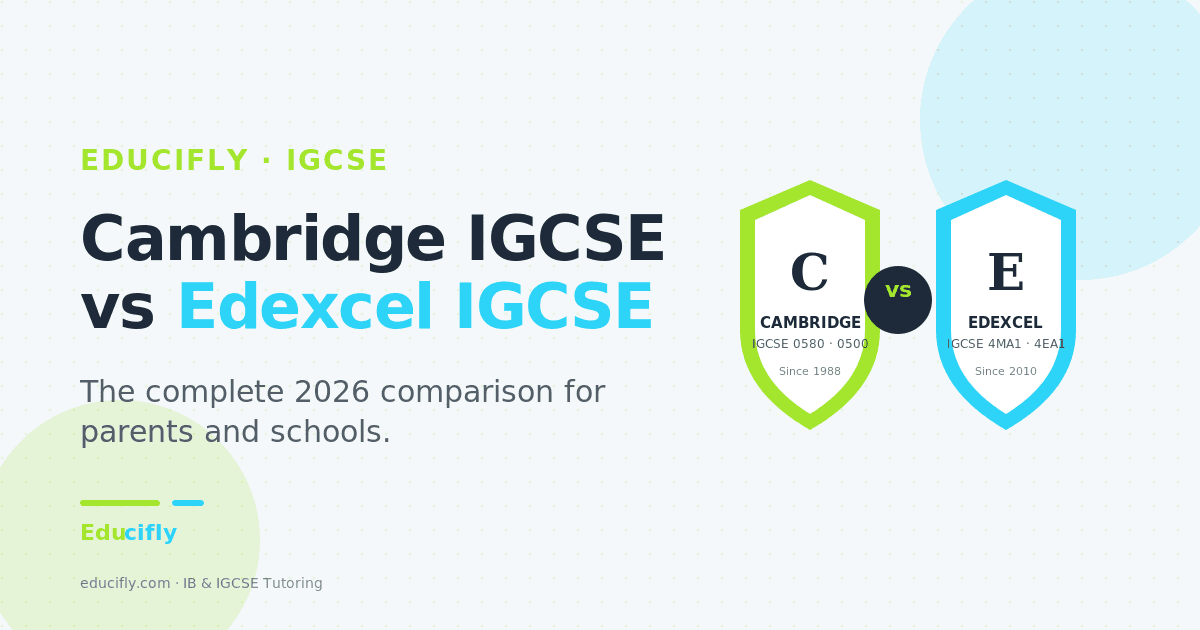
For families with children in Year 9 or Year 10 at an international school, the choice between Cambridge IGCSE and Edexcel IGCSE is rarely explained in detail. The two boards look almost identical from the outside — same age group, similar subjects, similar grading. Up close, they are quite different. The differences matter for grade outcomes, university recognition, and which subjects play to your child's strengths.
This guide is the comparison Educifly's IGCSE specialists have written for parents who want a clear, unsentimental answer.
Quick answer: Cambridge IGCSE vs Edexcel IGCSE
Cambridge IGCSE (offered by Cambridge International Examinations, part of Cambridge Assessment) is the older, more globally distributed IGCSE qualification. It is taken in over 160 countries and is the default IGCSE for most international schools outside the UK. Grading is 9 to 1 (or A* to G in some legacy subjects).
Edexcel IGCSE (offered by Pearson Edexcel) is the more recent IGCSE qualification, originally designed as an "international" version of the Pearson GCSE for use outside England. It is also taken globally but with stronger concentration in the UK independent school sector and select international schools. Grading is 9 to 1.
Both qualifications are accepted by virtually every major university worldwide. The deeper differences are in syllabus structure, exam pacing, grade boundaries, and fit with national education systems.
Cambridge IGCSE — at a glance
Feature | Cambridge IGCSE (2026) |
|---|---|
Awarding body | Cambridge Assessment International Education (CAIE) |
Year founded | 1988 |
Schools globally | ~10,000+ in 160 countries |
Grading scale | 9 to 1 (or A*–G in legacy syllabuses) |
Subjects available | 70+ |
Maths code (most popular) | 0580 (Extended) / 0580 (Core) |
English Language code | 0500 (First Language) / 0510 (Second Language) |
Combined Science code | 0653 (Coordinated) / 0654 (Combined) |
Typical exam season | May/June and Oct/Nov |
Coursework component | Optional in most subjects |
Edexcel IGCSE — at a glance
Feature | Edexcel IGCSE (2026) |
|---|---|
Awarding body | Pearson Edexcel |
Year founded | 2010 (current iteration) |
Schools globally | Several thousand worldwide |
Grading scale | 9 to 1 |
Subjects available | 40+ |
Maths code (most popular) | 4MA1 (Higher Tier) / 4MA1 (Foundation) |
English Language code | 4EA1 |
Combined Science code | 4SD0 |
Typical exam season | May/June and Jan |
Coursework component | Generally not required |
The single-most-asked operational question — can my child sit IGCSE in January? — is more often a yes with Edexcel. Cambridge runs two main sessions: May/June and Oct/Nov.
Side-by-side: which subjects differ most?
Mathematics
The biggest substantive difference between the boards is in Maths.
Cambridge IGCSE Mathematics (0580) has two tiers — Core and Extended. Extended is the standard tier for any student aiming at IB or A-Level Maths afterwards. The syllabus emphasises problem-solving with a mix of pure and applied content. Two papers, both calculator-allowed at the higher tier, with the second paper longer and including extended-response problems.
Edexcel IGCSE Mathematics (4MA1) is offered at Foundation and Higher tiers. Higher Tier is the standard for onward progression. The Edexcel Higher syllabus has historically had more advanced pure-mathematics content than Cambridge Extended — including more substantial work on calculus (differentiation and integration), vectors, and functions. Two papers, both calculator-allowed.
Bottom line for Maths: If your child is aiming at IB Math AA HL or A-Level Further Maths, Edexcel Higher Tier is arguably better preparation. If your child is aiming at IB Math AI or general numeracy, Cambridge Extended is comparable and slightly easier.
Sciences (Combined / Coordinated and Single)
Both boards offer Combined Science (a single GCSE-grade qualification covering Biology, Chemistry, Physics) and Single Sciences (separate qualifications for each).
Cambridge offers Combined Science (0653 Coordinated, two awards) and Combined (0654, single award), plus separate Biology, Chemistry, Physics single sciences.
Edexcel offers Combined Science as a Double Award only, plus the three Single Sciences separately.
Difference in practice: Cambridge Single Sciences are widely regarded as having slightly heavier required-practical and theoretical content than the equivalent Edexcel papers, while Edexcel's pacing is faster in the final exam papers (more questions per minute on average). Neither is "harder" overall — they reward different exam habits.
English Language
Cambridge IGCSE First Language English (0500) — two papers, focuses on reading comprehension, directed writing, and extended composition. The "Reading" paper is regarded by many teachers as one of the more demanding pieces of analytical work in any IGCSE.
Edexcel IGCSE English Language A (4EA1) — two papers, with stronger focus on transactional writing (letters, articles, speeches) and slightly less on extended literary analysis.
For children going on to IB English Lang & Lit or Literature HL, Cambridge tends to provide marginally stronger preparation for textual analysis. For those going on to A-Level English Literature, Edexcel's emphasis on structured argumentative writing is a fair match.
Other subjects
Geography, History, Economics, Business Studies, Computer Science, Art & Design, and most other subjects exist in both boards, with comparable rigour and similar grade boundaries. The differences narrow as the subjects get more specialised.
How are Cambridge and Edexcel IGCSEs graded?
Both boards now use a 9 to 1 grading scale for most subjects:
Grade | Approximate equivalence |
|---|---|
9 | Higher than the old A* |
8 | Solid A* |
7 | Strong A |
6 | High B |
5 | Strong pass (low B / high C) |
4 | Standard pass (C) |
3 | D |
2 | E |
1 | F/G |
For Edexcel IGCSE, the conversion from raw marks to grade is set by Pearson's grade-boundary committee each session. Cambridge does the same. Grade boundaries shift session by session — a 6 on a "hard" exam may require fewer raw marks than a 6 on an "easier" one.
A typical pattern in recent years has been that Cambridge has slightly higher grade boundaries at the top end for Maths and Sciences (e.g. ~85% raw for a 9), while Edexcel has slightly higher grade boundaries in English (e.g. ~80% raw for a 9). Both are competitive at the top end; both grade strictly.
Recognition: do universities care which IGCSE board you sat?
No major university in the UK, US, Canada, Australia, EU, India, the UAE, or Singapore distinguishes between Cambridge IGCSE and Edexcel IGCSE at admissions. Both are recognised as equivalent international school qualifications.
The exception is at the school level: some international schools in the UK independent sector use IGCSE grades for internal sixth-form admissions, and they sometimes have a slight historical preference for one board (typically the one their staff are accustomed to teaching). This is not a global trend.
For onward progression — to IB, A-Level, AP, IB Career-Related Programme, or a school's national curriculum — both boards are accepted as standard prerequisites.
Which IGCSE is harder?
This is the wrong frame — both qualifications are calibrated to be of comparable academic standard. But families ask, so here's the honest answer based on what Educifly's IGCSE specialists see across thousands of practice papers per year.
Maths. Edexcel Higher Tier is more demanding at the top end than Cambridge Extended, especially in calculus and vectors. A 9 in Edexcel Higher Tier Maths is regarded by many onward institutions as a slightly stronger signal than a 9 in Cambridge 0580 Extended — but only at the very top tail.
Sciences (single). Cambridge has slightly heavier content load; Edexcel is faster-paced in the exam. A child who is a methodical, deep-content learner often does better in Cambridge. A child who is a quick, agile exam performer often does better in Edexcel.
English Language. Cambridge 0500 is regarded by many teachers as the more analytically demanding paper. Edexcel 4EA1 is more structurally predictable, which can suit students who do well with templated writing.
Humanities (History, Geography, Economics). Comparable across both boards.
The overall conclusion: neither board is harder. The difference is in what kind of exam thinking each rewards. A reflective, content-driven student tends to do well in Cambridge; a fast, structurally predictable exam performer tends to do well in Edexcel.
Practical differences that matter day-to-day
Exam session timing
Edexcel offers a January exam session for most major subjects. Cambridge does not — its sessions are May/June and Oct/Nov. For students who want to sit IGCSEs across multiple sessions (resitting, or sitting one subject early), Edexcel's January session is a real flexibility advantage.
Past papers and resources
Cambridge IGCSE has been around longer and has a much larger pool of publicly available past papers, mark schemes, and revision resources. Edexcel's past-paper pool is smaller but still substantial.
For practice volume, Cambridge IGCSE students typically have access to 10+ years of past papers per subject; Edexcel students typically have 5–7 years of past papers per subject for the current syllabus iteration.
Resits
Both boards allow resits. Edexcel's January session makes resitting a single subject simpler — you can resit in January after a May/June exam, without losing a full academic year. Cambridge resits go six months out.
Teacher familiarity
In international schools in Singapore, Hong Kong, the UAE, India, Cambridge is the dominant board and most teachers are more experienced with it.
In international schools in UK-influenced markets (parts of Europe, the British school networks in Africa and the Middle East), Edexcel IGCSE is more common.
If your school offers a choice, ask which board their teachers have more recent experience teaching — five years of teacher familiarity beats the marginal syllabus differences every time.
How to choose between Cambridge IGCSE and Edexcel IGCSE
In most cases, the choice is made for you by your school — they offer one board, sometimes both, with limited flexibility per subject. Where you do have a choice, here's the decision framework Educifly uses with families.
Choose Cambridge IGCSE if:
Your school predominantly teaches Cambridge and your child is in the system already
Your child is a methodical learner who rewards deep content over speed
You're planning the IB Diploma afterwards (Cambridge IGCSE → IB is the most common pathway globally)
You want the largest pool of past papers and revision resources
Choose Edexcel IGCSE if:
Your school's onward pathway is A-Levels (Edexcel is the natural board-aligned progression)
Your child is a fast, exam-confident performer who works well with structured templates
You want flexibility with January sessions for resits or accelerated sitting
Your child is strong in Maths and you want the most rigorous IGCSE Maths preparation for onward HL maths courses
Don't choose based on:
"Which is easier?" — both grade strictly, and the perceived difficulty has shifted between boards across sessions
"Which has higher pass rates?" — pass-rate differences are usually explained by the student cohort, not the board
Marketing claims about being "more rigorous" or "more globally recognised" — both are widely recognised everywhere that matters
How Educifly tutors both IGCSE boards
Educifly's IGCSE specialists are tutors who teach one or two subjects deeply. They know the differences between Cambridge 0580 and Edexcel 4MA1 paper-by-paper, the chemistry differences between Cambridge 0620 and Edexcel 4CH1, and the specific exam habits each board rewards. We hand-match your child to a tutor who teaches the exact board and tier your school uses — never a generalist.
Our IGCSE Math tutors, IGCSE Physics tutors, IGCSE Chemistry tutors, and IGCSE English tutors coach students across both Cambridge and Edexcel pathways, in over 25 cities globally.
Book a free 30-minute trial class. The tutor will diagnose your child's current level on the board they're sitting, identify the two highest-leverage gaps, and propose a structured plan.
FAQ — Cambridge IGCSE vs Edexcel IGCSE
Is Cambridge IGCSE harder than Edexcel IGCSE?
Neither is uniformly harder. Cambridge tends to be more content-heavy in sciences and English; Edexcel tends to be more demanding in Maths Higher Tier. Both grade strictly at the top end and are calibrated to similar academic standards.
Are Cambridge and Edexcel IGCSE grades equivalent?
Yes — both use the 9 to 1 scale, and universities and onward schools treat the grades as equivalent. A 9 in Cambridge IGCSE is regarded the same as a 9 in Edexcel IGCSE by every major university worldwide.
Can I sit both Cambridge and Edexcel IGCSEs?
Yes, students can sit different subjects with different boards — this is common in international schools that offer both. There is no penalty for mixing boards across subjects.
Which IGCSE is better for IB?
Either prepares well for the IB. Cambridge IGCSE → IB is the historically more common pathway and most international schools are set up for it. Edexcel IGCSE Maths Higher Tier offers slightly stronger preparation for IB Math AA HL.
Which IGCSE is better for A-Levels?
Edexcel IGCSE aligns more naturally with Pearson Edexcel A-Levels (same publisher, similar pedagogy). Cambridge IGCSE also aligns well with Cambridge A-Levels and is accepted as a prerequisite for any A-Level board.
Can I resit an IGCSE exam?
Yes, with both boards. Edexcel's January session offers more flexibility for resitting a single subject without losing a year.
How many IGCSEs should my child take?
Most international schools require 7–9 IGCSEs across the two-year programme. Top universities typically expect at least 5 IGCSEs at grade 7 (A) or above, including Maths and English.
What's the difference between IGCSE Mathematics 0580 and 4MA1?
0580 is Cambridge IGCSE Mathematics; 4MA1 is Edexcel IGCSE Mathematics. 0580 Extended and 4MA1 Higher Tier are the standard tiers for onward progression. 4MA1 Higher Tier includes more advanced pure-mathematics content (calculus, vectors, functions) than 0580 Extended.
When are IGCSE exams?
Cambridge: May/June and Oct/Nov. Edexcel: May/June and January. Results are published roughly 3 months after the exam session.
How is the IGCSE different from a GCSE?
IGCSE is the international version of the GCSE, designed for use outside the UK national curriculum. The content is similar but the IGCSE has historically been calibrated for an international student cohort and typically has fewer coursework requirements than the UK GCSE. Both are widely recognised.
Need a specialist tutor who knows your child's exact IGCSE board, syllabus code, and tier? Book a free 30-minute trial class with Educifly — we'll match your child to an IGCSE specialist in their subject.